
Spanish Intensifiers: muy, -ísimo, super, un poco, más bien
By Michael McGettrick and Sergio Linares-HernandesUpdated 12 October 2026
(very) sits in the middle of a ladder. Spanish has words to turn a quality up past it, and words to turn it down:
Quick check
Three quick questions on what you have just read. The full practice is further down.
Spot the mistake
0/3Each sentence has one mistake. Tap it.
carísimo.- It's incredibly expensive..- It's a bit expensive.
The degree ladder at a glance
From softest to strongest:
- un poco caroa bit
- más bien carorather
- bastante carofairly
- muy carovery
- carísimoincredibly
| Rung | Spanish | English |
|---|---|---|
| not very | . | It's unlikely. |
| a bit | . | It's a bit expensive. |
| rather | . | It's rather expensive. |
| fairly | . | It's fairly expensive. |
| very | . | It's very expensive. |
| really | . | It's really expensive. |
| extremely | . | It's extremely expensive. |
| to the top | carísimo. | It's incredibly expensive. |
Turning it up: muy, -ísimo, sumamente
-ísimo is very turned up to the top, and it fits in speech and in writing. Drop the final vowel and add the ending:
| Adjective | -ísimo form | What happens |
|---|---|---|
carísimo | drop the vowel | |
grandísimo | drop the vowel | |
facilísimo | add; accent moves | |
riquísimo | c becomes qu | |
larguísimo | g becomes gu | |
felicísimo | z becomes c |
It agrees like any adjective:
carísimo- an incredibly expensive flatcarísima- an incredibly expensive house
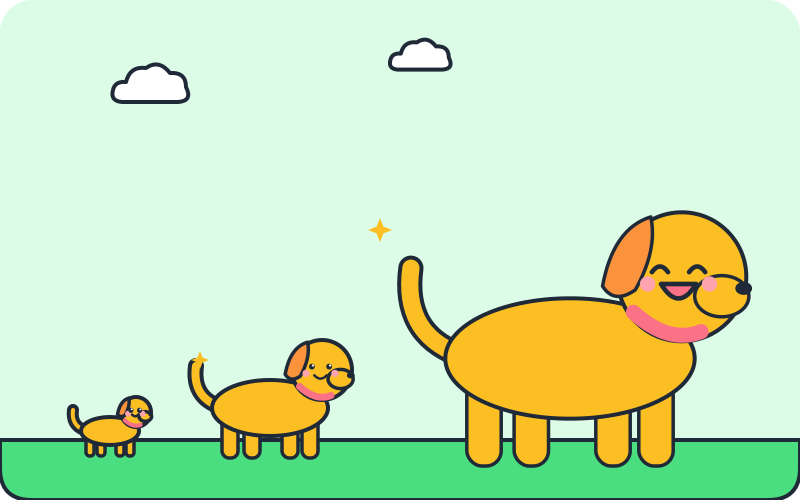
- grandísimo
Un perro pequeño: a small dog. Un perro normal: an ordinary dog. Un perro grandísimo: an enormous dog.
, enormemente and (extremely, enormously, really) go before the adjective and read well in an essay:
.- It's extremely important.
Colloquial boosters: super, requete-, un montón de
These are for speech and messages, not for an essay. The scale shows how far each one is from the exam hall:
- sumamenteextremely
- muyvery
- supercarodead expensive
- requetebiénreally, really well
| Booster | Spanish | English |
|---|---|---|
| super- | supercaro. | It's dead expensive. |
| requete- | requetebién. | You did it really well. |
. | It's really expensive. | |
. | There were loads of people. |
Super is written joined to the adjective. On its own it is , with an accent:
.- We had a great time.
+ adjective is everyday speech across the Spanish-speaking world, and especially frequent in Mexico.
Turning it down: un poco, más bien, medio
English speakers underuse these and sound blunter than they mean to:
| Downtoner | Spanish | English |
|---|---|---|
. | I'm a bit tired. | |
. | The soup's slightly cold. | |
. | He's rather shy. | |
. | She's half asleep. | |
. | He/she hardly speaks. | |
| no | . | Not very far. |
goes mostly with qualities you do not like. on its own ( ) turns the adjective negative:
.- He's a bit serious..- He's not very serious (unreliable).
before an adjective means half and does not change in standard Spanish: , not " ".
A word on bastante
is fairly, not very. is a moderate compliment:
.- It's pretty good.buenísimo.- It's brilliant.
It also means enough, and then it agrees with a plural noun:
.- I haven't got enough time..- There are enough chairs.
So... that: tan and tanto
and + turn degree into a result. goes before an adjective or an adverb and never changes; goes before a noun and agrees with it:
| Before | Spanish | English |
|---|---|---|
| an adjective | . | It's so dear I won't buy it. |
| an adverb | . | He talks so fast I can't follow. |
| a noun | . | So many people we didn't get in. |
| a noun | . | I' so many books they won't fit. |
| after a verb | . | He works so much we never see him. |
After a verb, does not change. Before , , and it is too: (all the better). Without , both work as exclamations:
¡ !- He's so good-looking!
Mistakes English speakers make
| Wrong | Right | Why |
|---|---|---|
| carísimo | carísimo | -ísimo already means very |
| before an adjective: | |
| before a noun: , agreeing | |
| before an adjective: | |
| does not agree here |
What to do next
- Swap one
a day for carísimo,. - Do the word-build and the sort below.
- Then Spanish exclamations:
¡ !,¡ !