
Advanced Spanish Negation: ni, tampoco, sino vs pero
By Michael McGettrick and Sergio Linares-HernandesUpdated 12 October 2026
Beyond no and , Spanish has a handful of sharper negatives, and two words for "but":
Quick check
Three quick questions on what you have just read. The full practice is further down.
Spot the mistake
0/3Each sentence has one mistake. Tap it.
.- I have neither time nor money..- It's not red but blue.
Advanced negation at a glance
The whole page on one screen.
| Word | Spanish | English |
|---|---|---|
| ... | . | I'm neither cold nor hot. |
. | He/She didn't even call me. | |
. | Me neither. | |
. | It's not red but blue. | |
. | It's expensive but good. | |
, . | He/She didn't come but phoned. | |
| no | . | I don't smoke any more. |
| no | . | He/She hasn't arrived yet. |
. | I don't like it at all. | |
. | I hardly know him. | |
| no | . | It's not that I don't want to. |
The negative words here (, , , ) follow the rule you already know from basic negation: before the verb it stands alone; after the verb, no goes in front.
Ni... ni: neither... nor
... rules out two things together. Where it sits decides whether no appears:
| Where | Spanish | English |
|---|---|---|
| after the verb | . | I have neither time nor money. |
| after the verb | . | I like neither coffee nor tea. |
| before it | Juan Pedro . | Neither Juan nor Pedro came. |
Two subjects before the verb usually make it plural: . The singular is heard too, but the plural is the safe choice.
A single joins a second negative, like English "nor" or "and not":
.- I don't know and I don't care..- Don't even think about it.
Ni siquiera: not even
denies even the least you could expect. Before the verb it stands alone; after it, no comes back:
| Where | Spanish | English |
|---|---|---|
| before | . | He/She didn't even call me. |
| before | . | He/She didn't even try. |
| after | . | I don't even have one . |
| after | . | He/She didn't even tell me his/her name. |
Plain can carry the same "not even" in speech, a little more bluntly:
- No me llamó.didn’t call me
- Ni me llamó.didn’t even call, casual
- Ni siquiera me llamó.didn’t even call
Tampoco: not either
agrees with a positive ("me too"); agrees with a negative ("me neither"):
| You hear | Agree with it | English |
|---|---|---|
. | . | Me too. |
. | . | Me neither. |
. | . | Me too. |
. | . | Me neither. |
After me , me and the other gustar-type verbs, agree with a , not yo.
In a full sentence, follows the usual rule:
.- I don't know either..- I don't know either.
Sino or pero
Both are "but". adds a contrast to something that still stands. throws out what you just denied and puts the right thing in its place, so it always follows a negative:
| Word | Spanish | English |
|---|---|---|
. | It's expensive but good. | |
, . | I want to go, but I haven't got time. | |
, . | It isn't expensive, but I don't like it. | |
. | It's not red but blue. | |
. | It wasn't me but my brother. | |
. | He/She studies law, not medicine. |
The third row is the trap: a negative in front does not force . Ask whether the second half replaces the first. "But rather" or "but instead" in English: . "But still" or "however": .
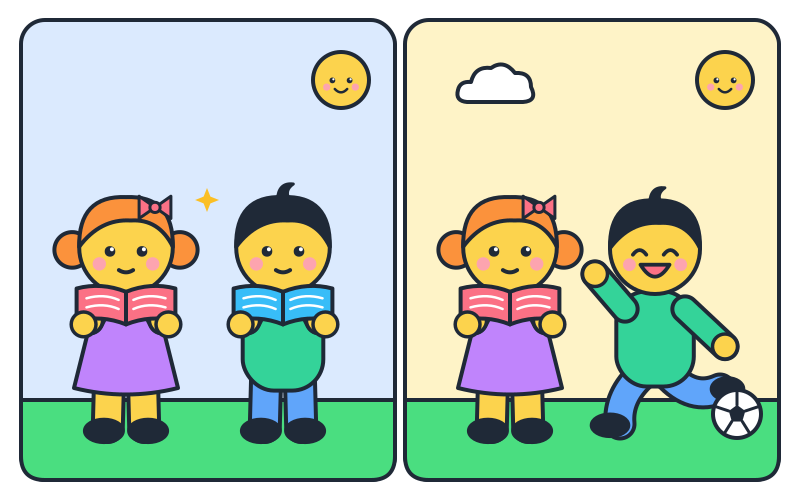
- .
- , .
Ella lee: she is reading. No lee, sino que juega al fútbol: he isn't reading; he's playing football instead.
Sino que and no solo... sino también
Before a conjugated verb, becomes . Before a word or a phrase, it stays :
| What follows | Spanish | English |
|---|---|---|
| a noun | . | He's not a teacher but a doctor. |
| a place | Madrid . | He/She lives in a village, not Madrid. |
| a verb | , . | He/She didn't come; he/she phoned instead. |
| a verb | , . | He/She doesn't throw it away but keeps it. |
The same builds "not only... but also":
, .- He/She is not only clever but also kind., .- He/She not only sings but dances too.
Ya no and todavía no
no says something has stopped; no (or no) says it has not started yet. They are the negatives of (still) and (already):
| Meaning | Spanish | English |
|---|---|---|
| still | . | I still smoke. |
| stopped | . | I don't smoke any more. |
| already | . | He/She has already arrived. |
| not yet | . | He/She hasn't arrived yet. |

- .
- .
Todavía hay comida: there is still some food. Ya no hay comida: there is no food left any more.
no goes before the verb and any pronouns, and needs nothing after it:
.- He/She doesn't live here any more..- I don't want it any more.¿ ?- Aren't you coming any more?
Strong negatives: para nada, en absoluto, apenas
To turn a plain no into a flat refusal, add one of these after the verb ( goes in front instead, with no no):
| Phrase | Spanish | English |
|---|---|---|
. | I don't like it at all. | |
. | It doesn't bother me in the slightest. | |
. | I don't agree at all. | |
. | Never in my life have I seen anything like it. |
is ; is firmer and a little more formal. On its own, each can be a whole answer: ¿ ? - . - Does it bother you? Not at all.
(hardly) is the soft one. Before the verb it needs no no:
.- I hardly know him..- He/She hardly eats meat.
No es que + subjunctive
No brushes aside a wrong reason ("it's not that..."), and the verb after it goes into the subjunctive, because you are denying it:
, .- It's not that I don't want to, it's that I can't., .- It's not that it's expensive; I just don't need it.
Mistakes English speakers make
| Wrong | Right | Why |
|---|---|---|
| no | | replaces : |
| no | , | a verb follows: |
| yo no | | me neither is |
| Juan Pedro no | Juan Pedro | before the verb: no no |
| no me | | not even is , never |
| no | | if you quit: no ( no is not yet) |
| no no | | no takes the subjunctive |
What to do next
- Before you write "but" after a negative, ask: replace, or add? Replace is
. - Do the brother story and the
orsort below. - Then the subjunctive after doubt and denial, where