
Spanish Quantifiers: mucho, poco, demasiado, todo, cada
By Michael McGettrick and Sergio Linares-HernandesUpdated 12 October 2026
Quantifiers say how much or how many. The trap is that , , , and agree with a noun but never change next to a verb or an adjective:
Quick check
Three quick questions on what you have just read. The full practice is further down.
Spot the mistake
0/3Each sentence has one mistake. Tap it.
.- There are a lot of people..- He/She works a lot.
Quantifiers at a glance
The whole page on one screen. A coloured ending agrees; a boxed word never changes.
| Word | Spanish | English |
|---|---|---|
| + noun | . | There are a lot of people. |
| + verb | . | He/She works a lot. |
| + noun | . | I have few friends. |
. | It's too expensive. | |
. | There are enough chairs. | |
| every day | |
| every two hours | |
| a couple of days | |
. | Most of my friends live abroad. | |
| more than a hundred people |
The family also lines up from nothing to too much:
- nadanothing
- poconot much
- un pocoa little
- bastantequite a lot, enough
- muchoa lot
- demasiadotoo much
Agree or freeze: mucho, poco, demasiado
One question decides the form: what does the word describe? A noun: it agrees in gender and number, like any adjective. A verb or an adjective: it never changes.
| Word | Agrees (noun) | Never changes |
|---|---|---|
| | |
| | |
| | |
| |
Watch the same word do both jobs in one sentence:
, .- There are a lot of people, but they don't talk much..- We have too many problems and too little time.
The classic is agreeing the frozen one: " ". is not a noun here, so the word stays .
One more case: before or with a noun, still agrees with the noun:
.- There were a lot more people..- It's a lot more expensive.
Bastante, tanto and un poco
Three members of the family have a quirk each.
| Word | The quirk | Example |
|---|---|---|
| changes for number only | | |
| quite, before an adjective | . | |
| becomes before an adjective | . | |
| stays before , | . | |
| a little, never agrees | . |
already ends in -e, so it has no feminine form: , . Its plural is .
and are not the same. is negative (not much); is positive (a little):
.- He/She doesn't say much..- He/She speaks a bit of English.
The full story of and in comparisons is on correlative comparison.
Todo: the whole, every, everything
agrees fully and, before a noun, usually takes the article (or another determiner, as in , all my friends). Singular means the whole; plural means every:
| Form | Spanish | English |
|---|---|---|
| masc. singular | | all day |
| fem. singular | | all night |
| masc. plural | | every day |
| fem. plural | | every week |
Two fixed uses to learn whole:
.- Everybody knows it. Singular verb: is one group..- I want it all. On its own, means everything.
Cada: each, and every two hours
never changes and takes a singular noun with no article:
| Spanish | English |
|---|---|
| each day |
| each person |
| each time |
| each one |
| every two hours |
The last row is the one job only can do: an interval with a number, where the noun is plural.
.- I take the pill every eight hours.
and both mean every day. takes the days one at a time, so it suits a change from day to day:
.- It gets colder every day..- I go to the gym every day.
Measure phrases: un par de, la mayoría de
Spanish has ready-made phrases for amounts, almost all built with :
| Phrase | Spanish | English |
|---|---|---|
| most people | |
| half the students | |
| loads of work | |
| a couple of days | |
| a dozen eggs | |
| a of apples | |
| a little water | |
| some money | |
| a few friends |
and go with things you cannot count (water, money). and go with things you can (friends, days). agrees: .
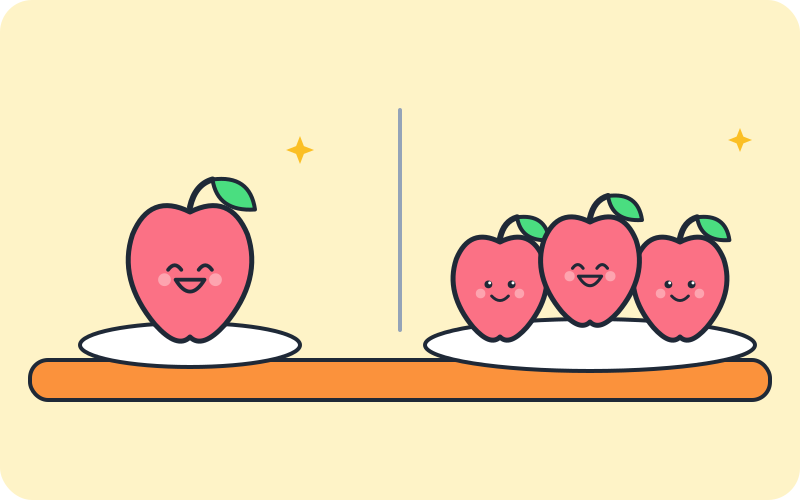
Una manzana: one apple. Unas cuantas manzanas: a few apples. Unos cuantos agrees with its noun, so the apples make it unas cuantas.
The verb after la mayoría de
is singular, but with and a plural noun most speakers make the verb plural. The singular is correct too, just less common:
| Verb | Spanish | English |
|---|---|---|
| plural | . | Most students work. |
| singular | . | Most students work. |
| plural | . | Half the books are mine. |
| plural | . | A couple of friends came to see me. |
With both are heard ( or ); the singular is the safer choice in writing. With a singular noun the verb is singular: . - Most people work.
Más de or más que
"More than" splits on what comes next. A number or an amount takes ; a person or thing being compared takes :
| What follows | Spanish | English |
|---|---|---|
| a number | | more than a hundred people |
| an amount | | less than half |
| a person | . | He/She knows more than me. |
| a thing | . | He/She runs more than his/her brother. |
| a clause | . | It costs more than I thought. |
One sentence can hold both: , . - There were more than a hundred people, more than last year.
The twist: in a negative sentence, no... means only:
.- I only have ten euros..- I have no more than ten euros.
Mistakes English speakers make
| Wrong | Right | Why |
|---|---|---|
| it describes : never changes | |
| it describes a verb: never changes | |
| never agrees | |
| with a noun, agrees | |
| an interval takes | |
| takes no article | |
| is singular | |
| a number takes |
What to do next
- Before you write
, find what it describes: noun or not. - Do the village story and the sort below.
- Next door: indefinites (
,,) and comparatives.