
/ˈɔːlməʊst/
Translation
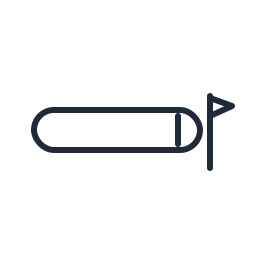
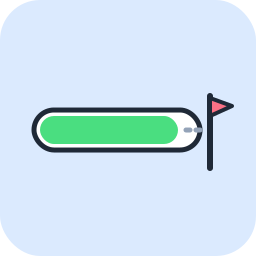
Very nearly, but not quite all the way or not quite complete.
Word origin
From Old English eallmaest, a joining of eall (all) and maest (most), meaning very nearly all.
- Origin
- Old English
- Root
- eallmaest
Examples
.
"Almost" means very nearly, but not quite.
.
"Almost" shows it is close to full, but not all the way.
.
"Almost" means we are very near, but not there yet.
We use almost to say that something is very near to being true or complete, but not quite. If a job is almost done, just a little is left. Almost means you are close, with only a small bit still to go.
Where this fits
Used in
Stories
(7)Grammar articles
(35)Articles in English: a, an, the and the zero article
British vs American grammar: have got, gotten, the team are, and the other quiet differences
Causative have and get in English: have something done, get something done and having someone do it
Cleft sentences in English: it was X who, what I need is, and how to move the emphasis
Comparatives and superlatives in English: the complete guide
Compound nouns in English: car park, coffee cup, and why GREENhouse is not green HOUSE
Countable and uncountable nouns in English: advice, information, news and the ones you simply have to learn
Discourse markers in English: well, anyway, actually, mind you and by the way
Future continuous and future perfect in English: will be doing vs will have done
Future in the past: was going to, would, was about to, and the grammar of plans that failed
Gradable and ungradable adjectives: why very furious sounds wrong, and which intensifier goes where
Hedging and vague language in English: sort of, a bit, -ish, stuff and or so
Inversion and word order in English: the subject-verb-object spine and when it flips
Linking words in English: however, although, even though, despite and therefore
Mixed conditionals in English: past causes with present results, and present causes with past results
Modal verbs in English: rules, examples and how to use them
Advanced passive structures in English: the get-passive, it is said that, and passives with two objects
Past continuous tense: was and were plus -ing, and when to use it instead of the past simple
Past perfect tense: had plus past participle, and when English actually needs it
Past simple tense: rules, examples and when to use it
Phrasal Verbs with Get: 16 Meanings You Actually Need
Phrasal Verbs with Go: 14 Meanings You Actually Need
Phrasal verbs in English: what they are, meanings, rules and examples
Prepositions in English: place, time and movement explained
Present continuous tense: form, spelling and uses
Present simple tense: rules, examples and when to use it
Quantifiers in English: some, any, much, many and more
Question tags in English: the mirror rule, aren't I, and tags after let's and imperatives
Reflexive and reciprocal pronouns in English: myself, yourself, each other, and when English does not bother
Reporting verbs in English: admit, deny, suggest, promise, and the pattern welded to each one
The subjunctive and the unreal past in English: I suggest he go, if I were you, and it's time we left
Time clauses in English: when, while, as soon as, until, before and after
Wish and if only in English: wish + past, wish + past perfect, wish + would, and why I wish I would is wrong
Word formation with prefixes: un-, in-, im-, dis-, re-, over-, under- and mis-
Word formation in English: how suffixes build word families and give away the part of speech
Add to review queue
Track this word in your spaced-repetition queue and be tested on it at the right interval.
Go to my review queueEnglish · Free printables
almost: worksheet, infographic and listicle
Free printable study downloads for the English word "almost" (Very nearly, but not quite all the way or not quite complete.): a worksheet with the answer key built in, an infographic, and a sentence listicle. Open any one to view, print or save.
Free for members
The printable worksheets, infographics and PDFs are free with an account. Start a free week and download as many as you like.
Start your free weekThis word is part of lesson 9.