
/θruː/

Translation
In at one side of something and out at the other side.
Word origin
From Old English thurh, shared with the old Germanic languages; the odd spelling keeps letters that English stopped saying.
- Origin
- Old English
- Root
- thurh
- English cognates
- thorough
Examples
.
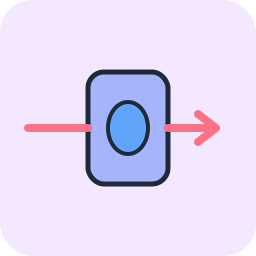
"Through" shows it enters one end and leaves the other.
.
"Through" means from one side to the other.
.
Here "through" means from the start to the end.
Used in
Stories
(13)One Sheep Short
4 min read · Core 5000
The Boat in the Garden
4 min read · Core 5000
The Broken Window
4 min read · Core 5000
The Clock in the Hall
4 min read · Core 5000
Two Gardens
4 min read · Core 5000
Not in Front of Them
5 min read · Core 1000
The Box in the Wood
5 min read · Core 5000
The First Letter
5 min read · Core 5000
The Midnight Piano
5 min read · Core 5000
The Night Route
5 min read · Core 5000
The Tuesday Visitor
5 min read · Core 5000
The Whale on the Beach
5 min read · Core 5000
The Last Light
8 min read · Core 5000
Grammar articles
(15)Articles in English: a, an, the and the zero article
British vs American grammar: have got, gotten, the team are, and the other quiet differences
Countable and uncountable nouns in English: advice, information, news and the ones you simply have to learn
Discourse markers in English: well, anyway, actually, mind you and by the way
Future continuous and future perfect in English: will be doing vs will have done
Future tense in English: will, going to and more explained
English grammar test: 30 questions with answers (A2-B2)
Inversion and word order in English: the subject-verb-object spine and when it flips
Modals of deduction in English: must be, might be, could be and can't be
Nominalisation in English: arrive becomes arrival, decide becomes decision, and why written English turns actions into things
Passive voice in English: rules, examples and when to use it
Prepositions in English: place, time and movement explained
Reporting verbs in English: admit, deny, suggest, promise, and the pattern welded to each one
The subjunctive and the unreal past in English: I suggest he go, if I were you, and it's time we left
Verb patterns with objects in English: want somebody to do, make somebody do, and see somebody doing
Add to review queue
Track this word in your spaced-repetition queue and be tested on it at the right interval.
Go to my review queueThis word is part of lesson 5.