
/ˈəʊvə/
Translation
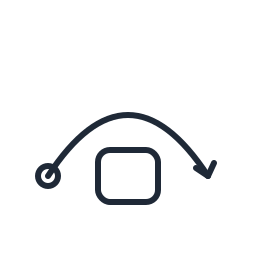
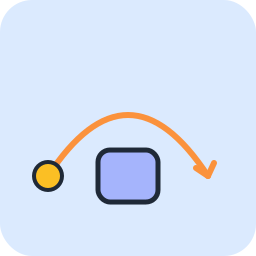
Above something, or across to the other side of it.
Examples
.
"Over" shows the bird went above the house.
.
Here "over" means across to the other side.
cloth .
"Over" shows the cloth covers the top of the table.
Used in
Stories
(17)The New Neighbour
3 min read · Core 1000
Before the Doors Open
4 min read · Core 5000
One Sheep Short
4 min read · Core 5000
The Broken Window
4 min read · Core 5000
The Letter She Never Sent
4 min read · Core 5000
The Long Way Home
4 min read · Core 1000
Two Gardens
4 min read · Core 5000
Not in Front of Them
5 min read · Core 1000
The Box in the Wood
5 min read · Core 5000
The Night Route
5 min read · Core 5000
The Register
5 min read · Core 5000
The Suggestion Box
5 min read · Core 5000
The Swimming Lesson
5 min read · Core 5000
The Tuesday Visitor
5 min read · Core 5000
The Whale on the Beach
5 min read · Core 5000
Two Tickets to Paris
5 min read · Core 5000
The Last Light
8 min read · Core 5000
Grammar articles
(24)Advanced articles in English: the zero article, the with names and places, and go to school vs go to the school
Articles in English: a, an, the and the zero article
Countable and uncountable nouns in English: advice, information, news and the ones you simply have to learn
Dummy subjects in English: it's raining, there's a problem, and why the subject slot is never empty
Ellipsis and substitution in English: I think so, neither do I, and the words you are allowed to leave out
Emphasis in English: I do like it, my own, the very, and how to push back
Future continuous and future perfect in English: will be doing vs will have done
Future in the past: was going to, would, was about to, and the grammar of plans that failed
Hedging and vague language in English: sort of, a bit, -ish, stuff and or so
Linking words in English: however, although, despite, whereas and therefore
Mixed conditionals in English: past causes with present results, and present causes with past results
Advanced passive structures in English: the get-passive, it is said that, and passives with two objects
Passive voice in English: rules, examples and when to use it
Past continuous tense: was and were plus -ing, and when to use it instead of the past simple
Past simple tense: rules, examples and when to use it
Phrasal verbs in English: rules, examples and how to use them
Prepositions in English: place, time and movement explained
Present perfect continuous: have been doing, and how it differs from the present perfect
Reporting verbs in English: admit, deny, suggest, promise, and the pattern welded to each one
The subjunctive and the unreal past in English: I suggest he go, if I were you, and it's time we left
Time clauses in English: when, while, as soon as, until, before and after
Verb patterns with objects in English: want somebody to do, make somebody do, and see somebody doing
Wish and if only in English: wish + past, wish + past perfect, wish + would, and why I wish I would is wrong
Word formation with prefixes: un-, in-, im-, dis-, re-, over-, under- and mis-
Add to review queue
Track this word in your spaced-repetition queue and be tested on it at the right interval.
Go to my review queueThis word is part of lesson 3.