
Ch 12 · Lesson 14Esperanto · Chapter 12 · Lesson 14 · Grammar primer
The article la, part two
, , but and plain Esperanto: where goes that English leaves bare, where it stays out, and the names that carry their own .
The short version
; .
Why?Hide
Three disagreements do most of the damage. Big abstract nouns often take in sayings: , , where English never has an article (bare is not wrong, just less usual there). Body parts usually take where English reaches for a possessive: ( is correct too). And professions after take nothing at all, because means he is THE teacher, the one we were discussing.
Where English instincts mislead you
English and Esperanto agree on most article decisions, which makes the rest dangerous. Three disagreements do most of the damage.
Big concepts often take la
When a noun names a whole concept, English drops the article. Esperanto may keep it, treating the concept as one known thing, and in sayings about big abstract nouns it very often does:
.- Life is beautiful..- Money does not bring happiness..- Time flies.
French and Spanish speakers will recognise the habit ( vie est belle, es bella). But it is an option, not a rule: plain general statements are at least as often bare, and is not wrong.
.- Water boils at a hundred degrees..- They felt love. (some of it, not love in general)
Body parts take la, not a possessive
Where English says my hands or her eyes, Esperanto very often says , because whose they are is not in doubt:
.- I washed my hands..- She closed her eyes..- He shook his head.
is also correct; it says a little more than it needs to. Keep the possessive for when the owner matters:
.- The doctor examined MY hands.
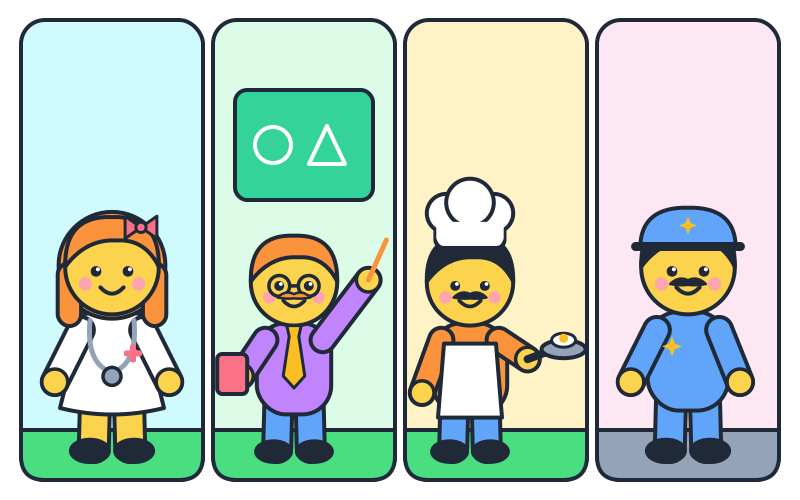
Professions after estas take nothing
.- He is a teacher..- She became a doctor..- He is THE teacher (the one we meant).
- .
- .
- .
A doctor, a teacher, a cook: after estas the job stands bare, with no word for a.
English inserts a; Esperanto does not, because the noun describes him rather than picking out one person. Adding is not a fix: it changes the meaning.
Proper names: no la, except when the la belongs to the name
Plain names take no article, as in English:
Parizo .-is big.Maria .- Maria came..- I speak Esperanto.
Geography is where English misleads. A one-word name stands bare even where English says the; plural names and names built from ordinary words take :
| Kind | Esperanto | English |
|---|---|---|
| one-word name | Atlantiko, Mediteraneo | the Atlantic |
| plural name | Alpoj | the Alps |
| from common words | | the Red Sea |
| name after a noun | Tamizo | the River Thames |
Atlantiko is common in practice, but PMEG counts it as a slip it tolerates, not the .
A title built from common nouns keeps its , because the article is doing its ordinary job inside the name:
And a name earns a when you narrow it to one version of itself:
Zamenhof- the young Zamenhof (oneof him out of several)Parizo- theof my youth
Going further: The core rule: known to both of us and the rest of the guide, when you want them. This lesson does not need them.
Practice
Practise this lesson
8-question session
One question at a time, mixed across the exercises in this lesson. Miss one and it comes back round before the end.
Esperanto · Free printables
Worksheets for this lesson
Worksheets with answer keys built in. Open any one to view, print or save.
Free for members
The printable worksheets, infographics and PDFs are free with an account. Start a free week and download as many as you like.
Start your free weekLesson 14 of 27 in this chapter