
Ch 16 · Lesson 8Esperanto · Chapter 16 · Lesson 8 · Grammar primer
Particles: ĉi tiu and kiu ajn
brings a ti- word near ( , , -); turns a ki- word into whoever, whatever, wherever. Neither ever takes an ending.
The short version
- .
Why?Hide
There is no this-series in the correlatives table and none is needed: pulls a ti- word towards the speaker. is that one, is this one; tie is there, is here. The order does not matter, being equally correct, and never inflects: the endings go on the correlative, . What you cannot do is drop the correlative, however much the hand wants . Hyphenated to a root it becomes a prefix: -, -, -.
, .
Why?Hide
after a ki- word and it means no matter which: (whoever), (whatever, as an object), (wherever), (however much). After an i- word it removes the limit: is anything at all. itself never takes an ending; the correlative keeps its own, as in . It does not go with the ti- words; after a neni- word it adds emphasis, , nobody at all.
Five small words that only work in company. makes a pointing word near, makes a question word mean no matter which, and build the more ..., the more ..., and stresses the word in front of it.
| Particle | Example | English |
|---|---|---|
| | this book |
| | whoever comes |
... | , . | The earlier, the better. |
... | , . | Now he laughs, now he cries. |
| . | I did it myself. |
ĉi: near, not a word for this
goes with a ti- word and brings it close to the speaker:
| Far | Near | English (near) |
|---|---|---|
| | this one |
| | this |
| | here |
| | this kind |
It can stand before or after the ti- word, with no difference in meaning:
.- This book is mine..- This book is mine.
never takes an ending. The -j and -n go on the correlative:
.- I read this book..- These people are my friends.
It needs the ti- word: is not standard. Say .
ĉi- as a prefix: ĉi-vespere
Joined to a root with a hyphen, makes one word meaning this, the present one:
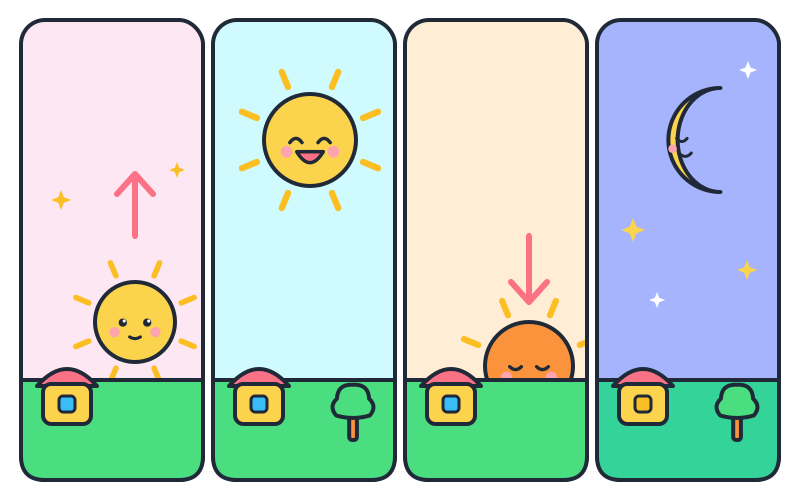
- -
- -
- -
Ĉi-matene, this morning (the sun rising); ĉi-vespere, this evening (the sun setting); ĉi-nokte, tonight (the moon).
| Word | English |
|---|---|
- | this evening |
- | this year |
- | this time |
- | above (in this text) |
- .- This evening I will read.
is also correct, and longer.
ajn: no matter which
follows a ki- or i- correlative and opens it up to any answer:
| Plain | With | English |
|---|---|---|
| | whoever, whichever |
| | whatever |
| | wherever |
| | whenever |
| | however much |
| | anyone at all |
| | anything at all |
A ki- word with opens a clause, like English -ever:
, .- Whoever comes, I will stay., .- Whatever you say, I will not believe it.
With an i- word it removes any limit:
.- Say anything at all.
never takes an ending; the correlative keeps its own:
.- Take whichever book you like.
It does not go with the ti- words: points at one known thing, so there is nothing to open up. After a neni- word it adds emphasis:
.- I saw nobody at all.
Going further: ju ... des: both halves and the rest of the guide, when you want them. This lesson does not need them.
Practice
Practise this lesson
8-question session
One question at a time, mixed across the exercises in this lesson. Miss one and it comes back round before the end.
Esperanto · Free printables
Worksheets for this lesson
Worksheets with answer keys built in. Open any one to view, print or save.
Free for members
The printable worksheets, infographics and PDFs are free with an account. Start a free week and download as many as you like.
Start your free weekLesson 8 of 27 in this chapter