
Ch 17 · Lesson 16Esperanto · Chapter 17 · Lesson 16 · Grammar primer
Instruisto or instruanto: role, trade or thing
-ant- is a role for now, -ist- a trade, -an- a membership: is teaching today, teaches for a living. And -aĵ- on the bare root makes a thing: o, a drink.
The short version
Petro, .
Why?Hide
Four suffixes make four claims. -ant- is a role for as long as it lasts (, a beginner), -ist- a trade (, a teacher), -an- a membership (o). So whoever is teaching this afternoon is the , trade or no trade. And -aĵ- on the bare root makes a thing, not a person: o, a drink.
Role, trade or member
Four suffixes make people, and each makes a different claim:
| Suffix | Claim | Example | English |
|---|---|---|---|
-- | doing it, while it lasts | | whoever is teaching |
-- | does it as a e | | a teacher |
-- | belongs to it | | a club member |
-- | is marked by it | | a young person |
against is the sharpest pair. An teaches for a living, even on holiday; an is whoever is teaching now, trade or no trade:
.- She is a teacher.Petro.- Today the one teaching is Petro.
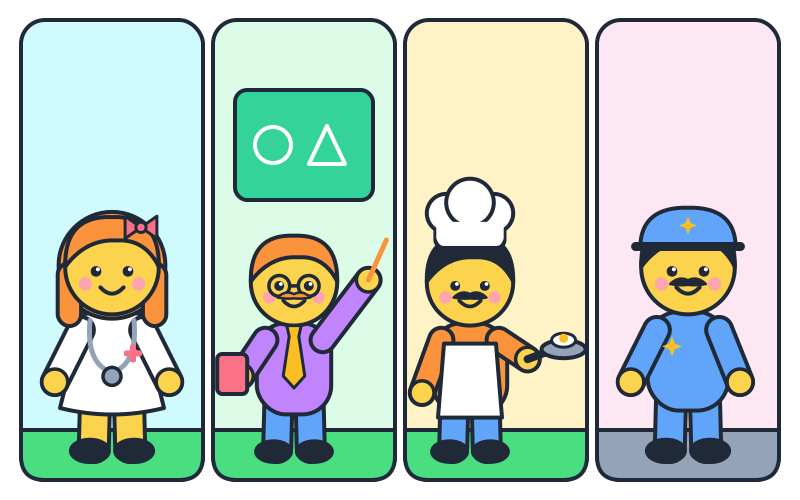
Kuracistino, a (woman) doctor; instruisto, a teacher; kuiristo, a cook. Each one's job, so -ist-. The teacher at the board is also an instruanto, for as long as he is teaching.
That is why a beginner is : beginning is a phase you grow out of, not a trade, so nobody is a o. is the usual word for a pupil or a learner on a course, and a university student is a .
-aĵ-: a thing, not a person
Put -- on the bare root instead and you get a concrete thing, not a person:
| Root | Thing | English |
|---|---|---|
| | a drink |
| | food |
| | a building |
| | a e of news |
on?- Would you like a drink?
The participle can go inside too: o is something that has been drunk. It is grammatical and heavier. Build on the bare root by default, and keep the participle form for when the finished action is really the point.
Going further: People who carry a tense and the rest of the guide, when you want them. This lesson does not need them.
Practice
Practise this lesson
9-question session
One question at a time, mixed across the exercises in this lesson. Miss one and it comes back round before the end.
Esperanto · Free printables
Worksheets for this lesson
Worksheets with answer keys built in. Open any one to view, print or save.
Free for members
The printable worksheets, infographics and PDFs are free with an account. Start a free week and download as many as you like.
Start your free weekLesson 16 of 26 in this chapter