
Ch 29 · Lesson 18Esperanto · Chapter 29 · Lesson 18 · Grammar primer
La korpo: the body words, head to foot
, , , , , , : the body in four tables, mostly international roots, and , a toe, built as a foot-finger.
The short version
A toe is a foot-finger:
.
Why?Hide
Most Esperanto body words are international roots you half know already: , , . Where English has a separate word, Esperanto often builds one from two you have: plus gives , a toe. And keep , the tongue in your mouth, apart from , a language.
Esperanto's body words are mostly international roots, and one rule matters more than the list: where the owner is obvious, Esperanto says where English says my or his.
.- I washed my hands..- He broke his arm..- The doctor examined my hands (mine, not yours).
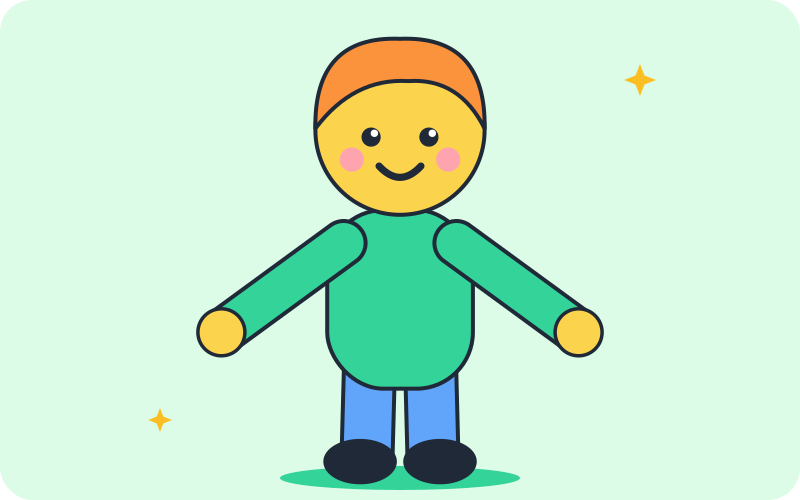
La kapo the head, la okuloj the eyes, la buŝo the mouth, la mano the hand, la brako the arm, la kruro the leg, la piedo the foot.
The head and the face
| Word | English | Note |
|---|---|---|
| head | |
| a single hair | the hair on your head: |
| forehead | |
| face | |
| eye | , the eyes |
| eyebrow | |
| ear | |
| nose | |
| cheek | |
| beard |
One hair is , so the hair on your head is plural:
.- She has long hair.
The mouth and the jaw
| Word | English | Note |
|---|---|---|
| mouth | |
| lip | |
| tooth | |
| tongue | the organ; a language is |
| chin | |
| jaw |
English tongue is both the muscle and the language. Esperanto keeps them apart:
is .- The coffee burnt my tongue..- My mother tongue is English.
The neck and the trunk
| Word | English | Note |
|---|---|---|
| neck | the whole neck |
| nape | only the back of the neck |
| throat | where a sore throat is |
| shoulder | |
| chest, breast | the front of the trunk |
| back | |
| waist | |
| belly | the everyday English stomach |
| heart | |
| lung | |
| stomach (the organ) | where digestion begins |
| kidney | |
| body | |
| limb; member of a group | one root for both |
.- The heart beats in the chest..- My back hurts.
The arms and the legs
| Word | English | Note |
|---|---|---|
| arm | |
| elbow | |
| hand | |
| finger | |
| nail | a claw is o |
| fist |
| Word | English | Note |
|---|---|---|
| leg | the commoner word, and Zamenhof's |
| leg | always the whole limb |
| thigh | |
| knee | |
| foot | |
| toe | a foot-finger: |
A toe has no root of its own. It is built, like many body words, from two you already have:
.- I broke a toe.
Going further: The rule: la, not mia and the rest of the guide, when you want them. This lesson does not need them.
Practice
Practise this lesson
10-question session
One question at a time, mixed across the exercises in this lesson. Miss one and it comes back round before the end.
Esperanto · Free printables
Worksheets for this lesson
Worksheets with answer keys built in. Open any one to view, print or save.
Free for members
The printable worksheets, infographics and PDFs are free with an account. Start a free week and download as many as you like.
Start your free weekLesson 18 of 29 in this chapter