
Ch 29 · Lesson 20Esperanto · Chapter 29 · Lesson 20 · Grammar primer
Kruro or gambo, ventro or stomako: precise body words
What the body is made of, the pairs English blurs (the leg, the belly and the stomach, a meaning and a sense), and the body idioms: , .
The short version
.
Why?Hide
is the commoner word, and Zamenhof used it almost always for the whole leg; in anatomy it can also mean just the part from the knee to the foot. always means the whole limb, and the lists it as a synonym of . For tired legs, either will do.
.
Why?Hide
English stomach is two things. is the belly, the part of the body between the chest and the pelvis. is the organ where digestion begins. So a punch lands , and the lists both and for the ache.
Inside, and what it is made of
| Word | English | Note |
|---|---|---|
| brain | |
| skull | the bone around the |
| skin | |
| bone | |
| muscle | |
| blood | |
| vein | an artery is arterio |
| nerve | |
| tear | the drop from your eye |
| voice |
.- The blood flows through the veins to the heart.
Three fences
Three pairs where English has one word, or Esperanto has two that look alike.
 a leg
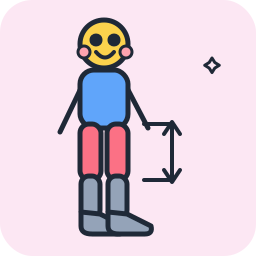 the thigh
 the belly
 the stomach, the organ
| Pair | One | The other |
|---|---|---|
| | |
| | |
| | |
and . Both mean leg. notes that Zamenhof used almost always for the whole limb, and that in anatomy it can also mean only the part from the knee to the foot. is always the whole limb, and lists it as a synonym of :
.- My legs are tired..- My legs are tired.
and . defines as the part of the body between the chest and the pelvis, and as the organ where digestion begins:
.- He hit me in the stomach.
and . The five senses are ; the meaning of a word is its . So (without meaning) means meaningless:
.- That is meaningless.
False friends has more pairs like this.
The body in idiom
All of these are in , and most of them take rather than a possessive:
| Esperanto | English |
|---|---|
| from head to foot |
| to lose one's head |
| to rack one's brains |
| to shake one's head (no) |
| to nod (yes): |
| to be clever |
| to have something to hand |
propramane | with one's own hand |
manenmane | hand in hand with |
Two proverbs:
, .- So many heads, so many opinions., .- Out of sight, out of mind.
is with the article shortened, which Rule 16 allows.
Going further: The head and the face and the rest of the guide, when you want them. This lesson does not need them.
Practice
Practise this lesson
8-question session
One question at a time, mixed across the exercises in this lesson. Miss one and it comes back round before the end.
Esperanto · Free printables
Worksheets for this lesson
Worksheets with answer keys built in. Open any one to view, print or save.
Free for members
The printable worksheets, infographics and PDFs are free with an account. Start a free week and download as many as you like.
Start your free weekLesson 20 of 29 in this chapter