
Ch 3 · Lesson 10Esperanto · Chapter 3 · Lesson 10 · Grammar primer
Estas varme: -e when there is no noun
, but : after , -a agrees with a noun, and with no noun (the weather, an infinitive, a clause) the -e takes over.
The short version
No noun to agree with, no -a:
, .
Why?Hide
An adjective's whole job is agreeing with a noun, so when the sentence has none the -a form has nothing to do. keeps its -a because is sitting there. has no subject at all, since Esperanto uses no dummy it, so the predicate falls back on the adverb ending. Same with an infinitive or a clause as subject: , , . Find the subject: noun or pronoun takes -a, anything else takes -e.
-a or -e after estas
After , look for the subject. A noun or pronoun gets an agreeing -a. No noun gets -e:
| Esperanto | English | Why |
|---|---|---|
. | The soup is warm. | |
. | It is warm. | no noun at all |
. | The house is lovely. | |
. | It is lovely here. | no noun at all |
- .
- .
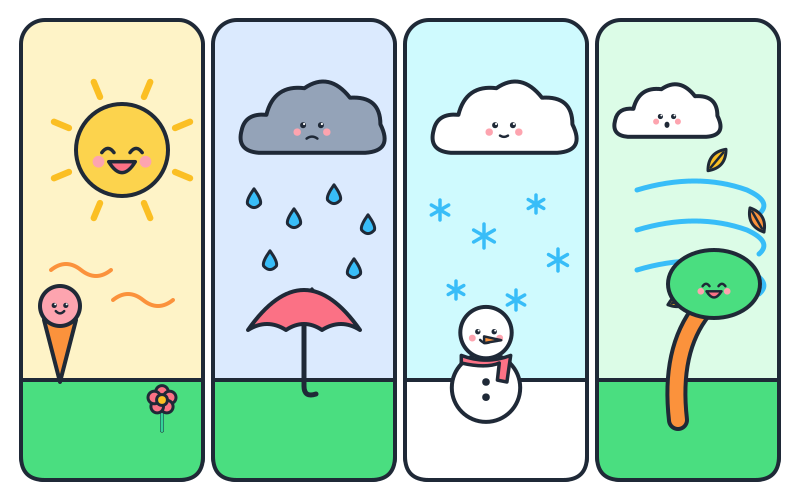
Estas varme (it is warm) under the sun, estas malvarme (it is cold) in the snow: weather has no noun, so -e.
Esperanto has no dummy it (English it is warm, French fait chaud). is the whole sentence, and an -a form would be an adjective with nothing to describe.
Of a soup, say : the pronoun gives the -a something to agree with. Of the weather there is nothing to put there, so sends your listener looking for the warm thing.
No noun: three kinds of subject
The -e is not only for the weather. It goes wherever the subject is not a noun or pronoun:
| Subject | Esperanto | English |
|---|---|---|
| nothing | . | It was cold. |
| an infinitive | . | Learning is easy. |
| an infinitive | . | It was nice to meet you. |
a | , . | It is good that you came. |
Compare the same word with a noun subject:
.- The lesson is easy..- Learning is easy.
English speakers usually slip the same way: -a where -e belongs, because English it is easy has a subject and the instinct wants something for the adjective to agree with.
Going further: -e from any root and the rest of the guide, when you want them. This lesson does not need them.
Practice
Practise this lesson
7-question session
One question at a time, mixed across the exercises in this lesson. Miss one and it comes back round before the end.
Esperanto · Free printables
Worksheets for this lesson
Worksheets with answer keys built in. Open any one to view, print or save.
Free for members
The printable worksheets, infographics and PDFs are free with an account. Start a free week and download as many as you like.
Start your free weekLesson 10 of 34 in this chapter