
Ch 4 · Lesson 9Esperanto · Chapter 4 · Lesson 9 · Grammar primer
Making and becoming: -ig- and -iĝ-
i is to seat someone, to sit down: -ig- does it to something, -iĝ- lets it happen. Both go on any root, and and are verbs on their own.
The short version
-ig- means cause it, -iĝ- means it happens
is ; is.
Why?Hide
Put -ig- on any root and you get a transitive verb meaning make it so. Put -iĝ- on and you get an intransitive one meaning go into that state. gives i, to heat something, and i, to get warm. gives i, to seat someone, and , to sit down. gives , to get married. One circumflex separates make it happen from it happened, so it is worth the keystroke.
-- makes someone do it to something; -- makes it happen by itself. English uses one verb both ways. Esperanto keeps them apart.
| Root | With -- | With -- |
|---|---|---|
| , warm | | |
| , to sit | | |
| , to boil | | ( |
| , to finish | ( | |
.- The water is boiling..- I am boiling the water.
Two suffixes, one fence
Every Esperanto verb sits on one side of a fence: it takes an object (transitive) or it does not (intransitive). The two suffixes are the way across:
--adds a causer. The new verb takes an object, and the object takes-n.--takes the causer away. The new verb takes no object at all..- He stopped the car..- The car stopped..- She closed the door..- The door closed.
- .
- .
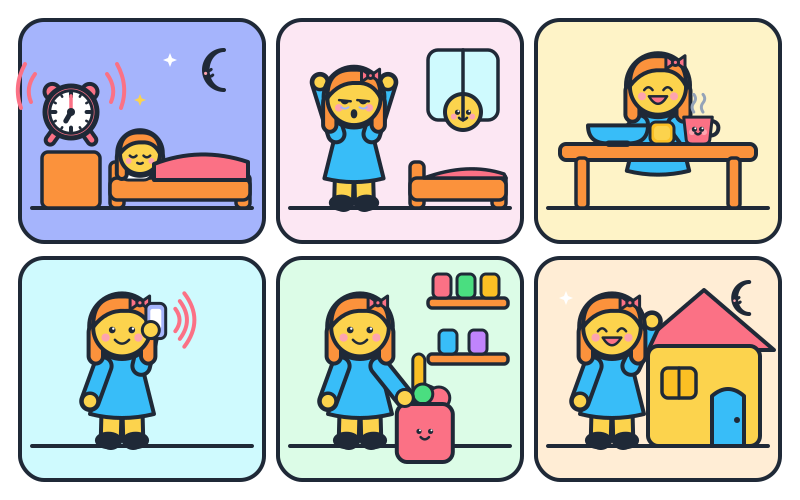
La horloĝo vekas ŝin: the clock wakes her (veki takes an object). Ŝi vekiĝas: she wakes up (nobody is woken by anyone).
One letter, g or ĝ, is the whole difference between make it happen and it happened.
They stick to anything
Both suffixes go on any root where the result makes sense, and the new word needs no dictionary's blessing:
| Root | With -- | With -- |
|---|---|---|
| , full | | |
| , husband | | |
| , to stand | | |
| , to know | | |
| for, away | | |
Several words you already know are built this way:
| Word | Pieces | English |
|---|---|---|
| -- | to kill |
| -- | to be born |
| -- | to become |
Londono.- I was born in London.
igi and iĝi on their own
Give the suffixes an ending and they are verbs in their own right. is to make, to cause; it takes an object plus an infinitive or an adjective:
.- He made me laugh..- That made me happy.
is to become, the same job as :
.- He became a teacher.
Going further: The transitivity traps and the rest of the guide, when you want them. This lesson does not need them.
Practice
Practise this lesson
8-question session
One question at a time, mixed across the exercises in this lesson. Miss one and it comes back round before the end.
New words in this lesson

Esperanto · Free printables
Worksheets for this lesson
Worksheets with answer keys built in. Open any one to view, print or save.
Free for members
The printable worksheets, infographics and PDFs are free with an account. Start a free week and download as many as you like.
Start your free weekLesson 9 of 31 in this chapter