
Ch 4 · Lesson 18Esperanto · Chapter 4 · Lesson 18 · Grammar primer
-u: commands, let us, and asking politely
! is come!, is let us go, ? is what should I do? And the strip from blunt to polite: , , .
The short version
-u gives commands, and is let us
.
Why?Hide
The -u ending marks what somebody wants to happen. On its own it is a command, , come!, with in front for a negative: . With it is let us, with it is let him, and with it asks what you are wanted to do: ?, what should I do? There is no separate word for let.
Polite requests:
?
Why?Hide
A bare command is blunt. plus an infinitive is please: , please sit down. is itself a -u form, so the verb after it stays an infinitive. Softer still is the conditional: ?, could you help me?, and , I would like.
-u: the command
The calls -u the imperative ( ). Many later grammars call it the volitive (from , to want), because it marks any action somebody wants to happen, not only an order. The plain command is the commonest case:
| Kind | Esperanto | English |
|---|---|---|
| one person or many | ! | Come! |
| negative | . | Do not be afraid. |
| , . | You stay here, I will go. |
There is no do to add in a negative command: goes in front and that is all. The bare form is the neutral command; stating points a finger.
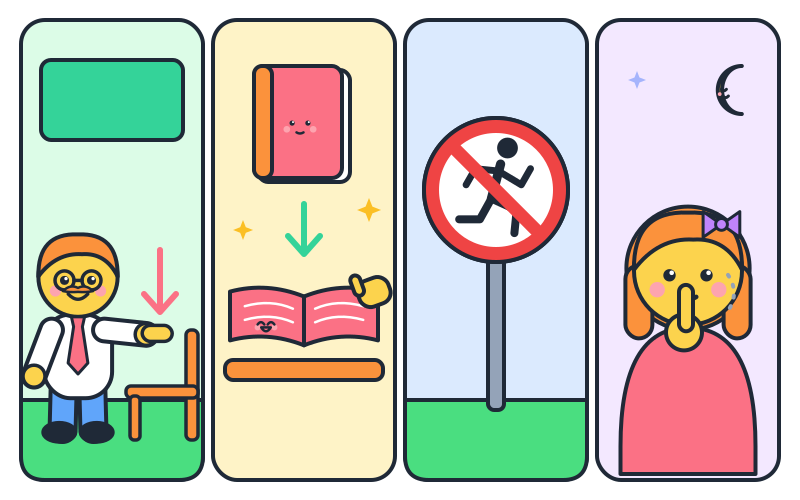
- !
- !
- !
- !
Sidiĝu! Sit down! Malfermu la libron! Open the book! Ne kuru! Do not run! Silentu! Be quiet! Every one is the root plus -u.
Ni iru, li venu, kion mi faru?
-u works with every person, which gives Esperanto one form for what English does with let, should and shall:
| Who | Esperanto | English |
|---|---|---|
| . | Let us go home. |
| . | Let him come at once. |
| ? | What should I do? |
| ? | Shall I open the window? |
| . | Everyone should do their own work. |
| a wish | ! | Long live the king! |
? asks what you are wanted to do. ? (what must I do?) is also correct, but it asks what is obligatory, which is a slightly different question.
From blunt to polite
A request can be a bare command, a , or a polite -us question. The strip runs from blunt to soft:
- Donu al mi akvon!give me water!
- Donu al mi akvon, mi petas.give me water, please
- Bonvolu doni al mi akvon.please give me water
- Ĉu vi povus doni al mi akvon?could you give me water?
| Form | Esperanto | English |
|---|---|---|
-i | . | Please sit down. |
| . | I would like to speak to you. |
| ? | Could you help me? |
is itself a -u form: is to be so kind as to, and the infinitive follows it. is not rude, but it lands like I want a word; is d like a word.
Going further: -us goes on both halves and the rest of the guide, when you want them. This lesson does not need them.
Practice
Practise this lesson
9-question session
One question at a time, mixed across the exercises in this lesson. Miss one and it comes back round before the end.
New words in this lesson

Esperanto · Free printables
Worksheets for this lesson
Worksheets with answer keys built in. Open any one to view, print or save.
Free for members
The printable worksheets, infographics and PDFs are free with an account. Start a free week and download as many as you like.
Start your free weekLesson 18 of 31 in this chapter