Esperanto grammar Part of Chapter 30

CEFR A2-B1

3 min read

Test yourself (21 questions)

Esperanto Restaurant Phrases: Ordering, Bonan Apetiton, Toasts

By Michael McGettrickUpdated 12 October 2026

At an Esperanto table you need one verb, (to order), and a few fixed phrases. Two of the phrases end in -n because a verb has been left out.

-n (the object of a verb left out)What do the colours mean?
EnglishEsperanto
ll have soup. .
Enjoy your meal! !
Cheers! !
The bill, please , .

Quick check

Now use it: three quick questions on the chart above. The full practice is further down.

Pick the right one

0/3

Pick the word that fits the cue.

  1. Mi akvon. (any drink at all)

  2. Li en la drinkejo. (alcohol, for pleasure)

  3. Mi . (I need to eat)

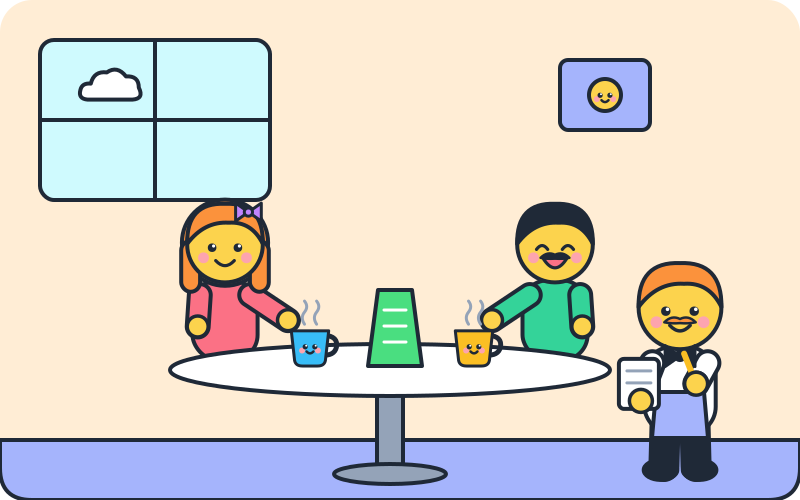
Inside a cafe: a woman with long hair and a bow and a man with a moustache sit at a round white table with a blue cup and a yellow cup of coffee and a green menu standing between them; a waiter, a man with a moustache, a bow tie and an apron, stands at the side writing on a notepad.

La klientino the customer (a woman), la kliento the customer (a man), la kelnero the waiter, la menuo the menu, la tasoj the cups.

Ordering: mendi

covers ordering food, ordering goods and booking a room. After a quantity word, such as a glass or a bottle, the food comes after , not :

  • . - I will have soup and a glass of wine.
  • . - I would like to order the fish.
  • . - We ordered a bottle of water.

, I would like, is the polite conditional. Quantity has the full rule for .

WordEnglish
restaurant
waiter
menu
a course
the bill
to pay

Bonan apetiton and je via sano

-n (the object of a verb left out)What do the colours mean?

! is said before a meal. The full sentence is , I wish you a good appetite. The verb has gone and the -n of its object has stayed. Other greetings and wishes have the same shape:

  • ! - Enjoy your meal!
  • ! - Good day!
  • ! - Thank you!

! is the toast, or just !. After there is no -n: the preposition already shows the role.

  • : ! - We raised our glasses: To your health!

is the preposition Esperanto uses when no other one fits, and PMEG advises avoiding it when a better one exists. In this fixed phrase it is the usual word. Tricky prepositions has more on .

Hungry, full and thirsty

Hunger and thirst are verbs in Esperanto:

Say itEnglish
.I am hungry.
.I am thirsty.
.I have had enough.
is.I had a snack.

, hungry, is - plus , full: there is no third root to learn. is also correct, but the verb is shorter.

How much you eat runs from a snack to your fill:

A littleYour fill
  1. manĝeti
  2. manĝi
  3. satiĝi
  • i - to eat a little, a snack between meals
  • - to eat
  • i - to eat until you are no longer hungry

Trinki or drinki

is to drink anything. is to drink alcohol: defines it as drinking something intoxicating for pleasure, to forget, or in ceremony.

  • . - I drink water.
  • . - They drank all night.

The family shows the register: a is a bar and a o is a drinker, someone fond of drink.

The meals and the card

WordEnglishBuilt from
breakfast +
lunch +
dinner +

gives two food senses: the list of dishes at a banquet or formal meal, and the card a restaurant hands you, which it defines under . Both words are understood; is the one you will hear.

Food in the proverbs

These are printed in under :

  • , . - Everyone eats as they arrange it.
  • . - Misery teaches you to eat bread without butter.
  • Mustardo . - Mustard after the meal: too late.

Mistakes English speakers make

WrongRightWhy
a glassful: after a quantity
. .the object of
! !no -n after
. . is only for alcohol

What to do next

  1. Order a meal aloud: a starter, a main course and a drink, with .
  2. Say ! and ! at your next meal.
  3. Read the food words for everything on the plate.

Practise: test yourself

Complete the story

0/5

Choose the word that fits each gap.

Dinner in town

La kelnero alportis la menuon. Mi supon kaj glason vino. Antaŭ la manĝo ni diris: Bonan ! Poste ni levis la glasojn: Je via ! Post tri pladoj mi estis tute .

Gap 1 of 5

Pick the right one

0/5

Pick the word that fits the cue.

  1. Mi akvon. (any drink at all)

  2. Li en la drinkejo. (alcohol, for pleasure)

  3. Mi . (I need to eat)

  4. Mi . (I need to drink)

  5. Mi nur iomete. (just a little, a snack)

Spot the mistake

0/3

Each sentence has one wrong word. Tap it.

Matching

0/4

Match each meal to its English.

Translation drill

0/4

Translate into Esperanto.

  1. I would like to order a soup.

  2. Enjoy your meal!

  3. I am hungry and thirsty.

  4. A glass of wine, please.

Chapters 1 and 2 free

This article is one lesson in a whole course

Every grammar point has its own article and drill, and the course wraps them in graded stories, games and printable worksheets, in the order you need them.

Chapters 1 and 2 free, forever. Plus: 7 days free, then $5 a month for all eleven languages.

Start learning free

Esperanto · Free printables

Practice worksheets and infographics

Practice worksheets with answer keys built in, plus infographic and listicle formats. Open any one to view, print or save.

Free for members

The printable worksheets, infographics and PDFs are free with an account. Start a free week and download as many as you like.

Start your free week

Frequently asked questions

How do you order food in Esperanto?
With the verb , to order: , I will have the soup. After a quantity word use , not : , a glass of wine. , I would like, is the polite form: . The waiter is the , and at the end you ask for the bill: , .
Why is it and not ?
Because it is the object of a verb that has been left out. The full sentence is , I wish you a good appetite, and the -n stays when the verb goes. , and have the same shape. It is what you say before a meal, the way English speakers borrow bon appétit.
How do you say cheers in Esperanto?
, to your health, or just . is the preposition Esperanto uses when no other one fits, and PMEG advises avoiding it when a better one exists, but in this fixed phrase it is the usual word. Note there is no -n on after : a preposition already shows the role.
How do you say I am hungry in Esperanto?
, using the verb , to feel the need to eat. , with the adjective, also works. Thirst works the same way: , I am thirsty. When you have eaten enough you are , satisfied, and is simply mal- plus , so there is no separate root to learn for hungry.
What is the difference between and ?
is to drink anything: . is to drink alcohol, and the defines it as drinking something intoxicating for pleasure, to forget, or in ceremony. Its family shows the register: a is a bar and a o is a drinker, someone fond of drink. So you your tea, and makes no sense.