
/sɥivʁ/
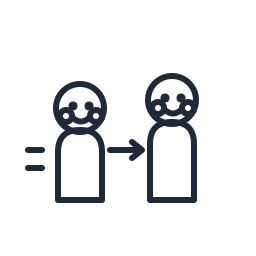

Translation
to follow
Word origin
From Vulgar Latin sequere, an alteration of Latin sequi ('to follow').
- Origin
- Vulgar Latin
- Root
- sequere (sequi)
- English cognates
- sequence, sequel, consecutive
Grammar
Conjugation
Regular french-irregular conjugation. Pronouns: je, tu, il/elle, nous, vous, ils/elles.
Indicative
| Person | Present | Imperfect | Past historic | Future | Conditional |
|---|---|---|---|---|---|
| je | suis | suivais | suivis | suivrai | suivrais |
| tu | suis | suivais | suivis | suivras | suivrais |
| il/elle | suit | suivait | suivit | suivra | suivrait |
| nous | suivons | suivions | suivîmes | suivrons | suivrions |
| vous | suivez | suiviez | suivîtes | suivrez | suivriez |
| ils/elles | suivent | suivaient | suivirent | suivront | suivraient |
Subjunctive
| Person | Present | Imperfect |
|---|---|---|
| je | suive | suivisse |
| tu | suives | suivisses |
| il/elle | suive | suivît |
| nous | suivions | suivissions |
| vous | suiviez | suivissiez |
| ils/elles | suivent | suivissent |
Imperative
| Person | Affirmative |
|---|---|
| tu | suis |
| nous | suivons |
| vous | suivez |
Non-finite
- Gerund / present participle
- suivant
- Past participle
- suivi · suivie · suivis · suivies
Examples
-, ' .
Follow me, I will show you the way to the reception.
.
She takes a dance class on Tuesday evenings.
.
It is difficult to follow a conversation when there is too much noise.
-, .
Follow me, I know how to get to the station.
.
It is hard to follow this class without a book.
est un verbe irregulier du troisieme groupe. Suivre quelqu'un (to follow someone) et suivre un cours (to attend a course, to follow a course) sont les deux emplois les plus frequents. Se suivre (to follow one another) est la forme pronominale.
Comme suit (as follows) est une formule administrative. Faire suivre (to forward) s'emploie pour le courrier et les emails. Suivez l'actualite (follow the news) et suivre un regime (to follow a diet) illustrent la polyvalence du verbe. Suite (f) est le nom derive indispensable.
Where this fits
Used in
Grammar articles
(1)Add to review queue
Track this word in your spaced-repetition queue and be tested on it at the right interval.
Go to my review queueFrench · Free printables
suivre: worksheet, infographic and listicle
Free printable study downloads for the French word "suivre" (to follow): a worksheet with the answer key built in, an infographic, and a sentence listicle. Open any one to view, print or save.
Free for members
The printable worksheets, infographics and PDFs are free with an account. Start a free week and download as many as you like.
Start your free weekThis word is part of lesson 6.