
Ch 2 · Lesson 25German · Chapter 2 · Lesson 25 · Grammar primer
Separable verbs: the prefix jumps to the end
becomes an. The little word on the front of the verb splits off and waits at the end of the sentence.
The short version
Separable verbs: the prefix always goes last
.
Why?Hide
A verb like splits in a main clause. The stem takes second place, as any German verb does, and the prefix jumps to the very end of the clause, however much sits in between. (In a clause with or the verb goes last and the prefix stays on: .) Listen for the last word before you decide what the verb was: the prefix is where the meaning lands.
Some German verbs break in two. (to phone) is one word in the dictionary, but in a sentence the stem goes second, like any verb, and the prefix jumps to the end: . - I'll call you. This page covers that split in the present tense.
The whole system on one screen
| Sentence type | Example | English |
|---|---|---|
| statement | . | I'm calling my mother. |
| yes/no question | ? | Are you starting now? |
| command | ! | Please call me! |
| with a modal | . | I have to get up early. |
| ver-, be-, er- | . | I don't understand that. |
The prefix goes to the end
In a main clause the stem is conjugated like any verb and sits in second place. The prefix waits at the very end, however long the clause:
- .
- .
- .
- .
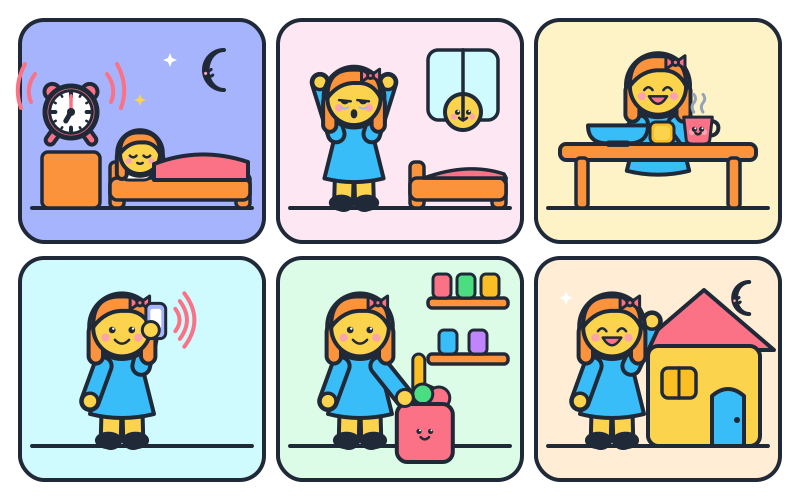
Her day in four separable verbs: aufstehen, anrufen, einkaufen, zurückkommen. Each one splits, and the prefix lands at the end.
| Infinitive | Example | English |
|---|---|---|
| . | I'm calling my mother. |
| . | You get up early. |
| . | We're starting now. |
| . | He looks at the house. |
| . | She doesn't stop. |
The prefix is half the meaning. is to stand, to get up, so the sentence only makes sense at its last word. This is the verb-second rule from German word order, applied to a verb that comes in two pieces.
A stem that changes its vowel does so exactly as the plain verb does:
.- He is starting now. (,.- He looks at the house. (,
Questions and requests
Wherever the stem goes, the prefix still goes to the end:
| Type | Example | English |
|---|---|---|
| yes/no | ? | Are you starting now? |
| question word | ? | Why are you getting up? |
| command, | ! | Please call me! |
| command, | ! | Please call me! |
In a yes or no question and in a command the stem comes first; with a question word it is second, as always. The command drops the ending (), and the command puts straight after the stem.
Going further: Which prefixes split off and the rest of the guide, when you want them. This lesson does not need them.
Practice
Practise this lesson
8-question session
One question at a time, mixed across the exercises in this lesson. Miss one and it comes back round before the end.




German · Free printables
Worksheets for this lesson
Worksheets with answer keys built in. Open any one to view, print or save.
Lesson 25 of 37 in this chapter