
Italian Reflexive Verbs: When the Action Loops Back
By Michael McGettrickUpdated 12 October 2026
A reflexive verb loops back on its subject: Anna, literally I call myself Anna. The infinitive ends in -si (), and a small pronoun goes in front of the verb. Italian uses these verbs for waking, getting up, feeling, remembering and worrying, where English sees nothing reflexive at all.
Quick check
Three quick questions on what you have just read. The full practice is further down.
Pick the right one
0/3Pick the reflexive pronoun that matches the subject.
Io chiamo Anna.
Come chiami?
Noi vediamo domani.
The whole system on one screen
| Piece | Example | English |
|---|---|---|
| infinitive in - | | to be called |
| present | Anna. | My name is Anna. |
| past: | . | I got up (a woman). |
| after a modal | . | I have to get up. |
| command | ! | Get up! |
| each other | . | See you tomorrow. |
The pronoun always matches the subject. In the past, the helper is , and the ending agrees.
The reflexive pronouns
Each person has its own pronoun, and the verb conjugates as normal behind it:
| Subject | chiamarsi | sentirsi |
|---|---|---|
| | |
| | |
| | |
| | |
| | |
| | |
serves he, she, they and the polite , so one question asks two things:
?- What's your name? (to a friend)?- What's his name? What's her name? What's your name? (polite)
The subject pronoun usually goes: already says I twice.
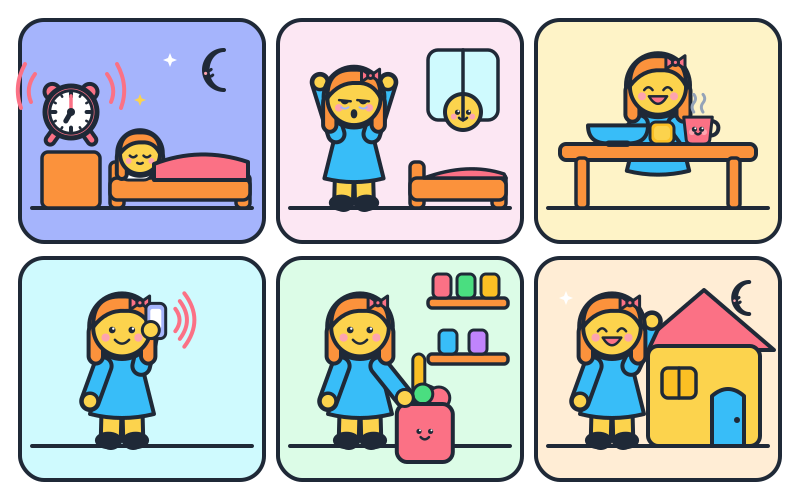
- .
- .
Si alza: she gets up, literally she raises herself, a reflexive verb. Fa colazione: she has breakfast, an ordinary verb with no pronoun.
Same verb, different meaning
Many verbs exist with and without -si. Without it, you do something to someone else; with it, to yourself:
| Without -si | With -si | English (with -si) |
|---|---|---|
| | to be called |
| | to get up |
| | to wash (yourself) |
| | to feel |
| | to be, to get on |
| | to put on (clothes) |
The last three change meaning more than English would predict. Drop the pronoun and the sentence turns into something else:
.- I can hear the music..- I feel well..- I can't find the keys..- I like it here. I'm getting on well here.
Reflexive in Italian, not in English
The biggest group is reflexive in Italian and an ordinary verb in English. There is no logic to extract; learn the -si with the verb:
| Italian | English | Example |
|---|---|---|
| to remember | . - I remember you. |
| to forget | . - I forgot. |
| to worry | . - Don't worry. |
| to have fun | . - We're having fun. |
| to trust | . - I trust you. |
| to stop | . - We'll stop here. |
| to get married | . - They got married. |
| to sit down | . - He/she sits down. |
and also exist without -si, with the same meaning and no :
.- I remember everything..- I remember everything.
Each other: the reciprocal use
In the plural, , and can mean each other:
.- See you tonight. (We'll see each other.).- They love each other.?- Do we know each other?
is the everyday goodbye after : a reflexive verb in plain sight.
Body parts and clothes: no possessive
For your own body and clothes, Italian uses a reflexive verb and the plain article where English uses my:
.- I wash my hands..- I put my shoes on.
is not wrong so much as oddly insistent: the already says whose hands.
The si that is not reflexive
with an ordinary third-person verb can also mean one, people or you in general, with nobody looping back on anybody:
| Example | English |
|---|---|
? | How do you say it? |
. | You eat well here. |
. | You never know. |
The test: if one or people fits, it is this impersonal ; if himself, herself or themselves fits, it is reflexive.
Reflexive verbs in the past: always essere
In the , a reflexive verb takes , not , and the pronoun goes in front of the helper (the one twist, with a modal, is below). Because the helper is , the participle agrees with the subject:
| Subject | Man, mixed group | Woman, women |
|---|---|---|
| | |
| | |
| | |
| | |
| | |
| | |
- .
- .
Si è alzata: she got up, reflexive, so essere, and the ending agrees with her. Ha fatto colazione: she had breakfast, an ordinary verb with avere.
The rule catches verbs whose plain twin takes :
.- I raised my hand..- I got up early.
With infinitives and commands
After , and , the -si on the infinitive changes to match the subject:
The pronoun can also go in front of the modal. Both are standard, and the choice decides the helper in the past:
| Pronoun | Present | Past |
|---|---|---|
| on the end | . | . |
| in front | . | . |
All four say I have (or had) to get up. In an informal command the pronoun goes on the end:
!- Get up!!- Hurry up!!- Don't worry! (also!)
More on pronouns with the imperative.
Mistakes English speakers make
| Wrong | Right | Why |
|---|---|---|
| . (I feel) | . | alone means hear |
| ho . | . | reflexive: |
| (a woman) | . | : the ending agrees |
| . | . | - matches the subject |
| . | . | goes with |
What to do next
Reflexive verbs are on the Pearson Edexcel GCSE Italian specification at Foundation and Higher tier.
- Learn each one with its -si, as you learn a noun with its article.
- Say five things you did this morning:
.... - Next: the imperfetto, the past for what was going on.