
Ch 2 · Lesson 36Mandarin · Chapter 2 · Lesson 36 · Grammar primer
Requests: 请, 别 and 吧
Asking nicely in Mandarin: (qǐng) + verb, (bié) and (bú yào) for don't, and (ba) to turn an order into a suggestion.
The short version
。。Qǐng zuò. Bié kèqi.
Why?Hide
Put (qǐng) before the verb to ask politely: (qǐng jìn), please come in. (bié) or (bú yào) before the verb says don't: (bié zǒu), don't go. Add (ba) at the end and an order becomes a suggestion: (wǒ men zǒu ba), let's go.
Plain imperatives
The plainest imperative is the verb, with no subject and no marker:
| Hanzi | Pinyin | English |
|---|---|---|
! | Zuò! | Sit! |
! | Kàn! | Look! |
! | Zǒu! | Go! / Move! |
。 | Tīng wǒ shuō. | Listen to me. |
Between family and close friends, or in a real hurry, this is fine. Said to a stranger or a colleague, it lands as rude. (nǐ) in front changes little: 。 (Nǐ lái.) - You, come here.
Polite request: 请 (qǐng) + verb
(qǐng) means "to invite". Put it in front of the verb and the order becomes a polite request:
| Hanzi | Pinyin | English |
|---|---|---|
。 | Qǐng zuò. | Please sit down |
。 | Qǐng jìn. | Please come in |
。 | Qǐng děng yíxià. | Please wait a moment |
。 | Qǐng gěi wǒ nà běn shū. | Please pass me that book |
(qǐng) is the one to use with waiters, strangers and anyone you do not know well. (qǐngwèn), "may I ask", is the standard "excuse me" before a question:
,?(Qǐngwèn, xǐshǒujiān zài nǎr?) - Excuse me, where's the toilet?
Negative imperatives: 别 (bié) and 不要 (bú yào)
For "don't", put (bié) or (bú yào) in front of the verb. They mean the same:
| Hanzi | Pinyin | English |
|---|---|---|
! | Bié zǒu! | Don't go! |
。 | Bié dānxīn. | Don't worry |
。 | Bú yào shuōhuà. | Don't talk |
。 | Bú yào wàng le. | Don't forget |
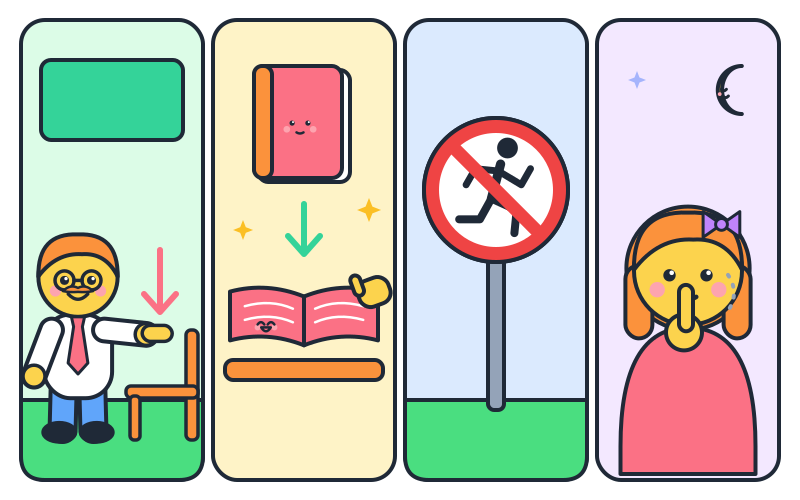
- 。
- 。
- !
- !
A classroom in four orders: 请 qǐng to ask politely, the bare verb to tell, 别 bié in front for don't.
(bié) is the everyday spoken form; (bú yào) is a touch firmer, and (qǐng bú yào) is common on signs. For "please don't", add (qǐng): (qǐng bié shuōhuà), please don't talk.
Softening particles: 吧 (ba) and 啊 (a)
A particle at the end of the sentence changes how the order lands.
吧 (ba): a suggestion, or let's
| Hanzi | Pinyin | English |
|---|---|---|
。 | Wǒmen zǒu ba. | Let's go |
。 | Nǐ zuò ba. | Do sit down |
。 | Hǎo ba. | All right then (reluctantly) |
(ba) turns (nǐ zuò), sit, into (nǐ zuò ba), an invitation. With (wǒmen) it is English "let's".
啊 (a): warmer, or more insistent
| Hanzi | Pinyin | English |
|---|---|---|
! | Lái a! | Come on! |
! | Nǐ shuō a! | Go on, say it! |
。 | Bié dānxīn a. | Don't you worry |
(a) is casual. It can make an order friendlier between friends, or push it: "come on, just do it". Tone of voice decides which.
Going further: The toolkit on one screen and the rest of the guide, when you want them. This lesson does not need them.
Practice
Practise this lesson
10-question session
One question at a time, mixed across the exercises in this lesson. Miss one and it comes back round before the end.
New words in this lesson

Mandarin · Free printables
Worksheets for this lesson
Worksheets with answer keys built in. Open any one to view, print or save.
Lesson 36 of 44 in this chapter