
Ordering and Paying in Brazilian Portuguese: Eu Queria um Café
By Michael McGettrickUpdated 12 October 2026
Order with ... and the thing you want, ask the price with ?, and finish with , . Those three cover every , lanchonete and restaurant in Brazil:
Quick check
Three quick questions on what you have just read. The full practice is further down.
Spot the mistake
0/3Tap the mistake.
, .- I'd like a coffee, please.?- How much is it?
This page teaches Brazilian Portuguese and labels where differs.
The whole exchange on one screen
| You want to | Portuguese | Note |
|---|---|---|
| order (polite) | . | I'd like |
| order (at table) | . | I'll have |
| order (counter) | . | casual, Brazil only |
| ask the price | ? | how much is it? |
| hear the price | . | R$ 8,50 |
| ask for the bill | , . | the bill, please |
| say how you pay | . | by card |
| tip | . | keep the change |
Add to any of them. (a man speaking) or (a woman speaking) closes the exchange.
Asking for something: eu queria, vou querer
Four everyday ways to ask, from casual to polite:
- Me vê um café.give me (counter)
- Vou querer um café.I’ll have (table)
- Pode me trazer um café?can you bring me
- Eu queria um café.I’d like (anywhere)
| Where | Portuguese | English |
|---|---|---|
| anywhere | . | I'd like a coffee. |
| at the table | . | I'll have a juice. |
| at the counter | . | Give me a cheese bread. |
| to the waiter | ? | Can you bring me a glass? |
is literally "I wanted", but it is how Portuguese says "I'd like". (I want) is fine in Brazil, but with no it can sound abrupt to a stranger:
, .- A coffee, please. (fine, a little direct)
is pure Brazilian counter talk. Standard European Portuguese does not start a sentence with (it puts the after the verb), so in Lisbon say ... instead.
Um or uma
What you order takes (masculine) or (feminine). Learn each word with its article:
 a coffee
 a juice
 a water
 a beer
| Masculine | Feminine |
|---|---|
| |
| |
| |
A cup or glass of something takes , like English "of":
At the padaria
The is the Brazilian bakery-: coffee at the counter, bread for breakfast, snacks all day. The person behind the counter usually speaks first.
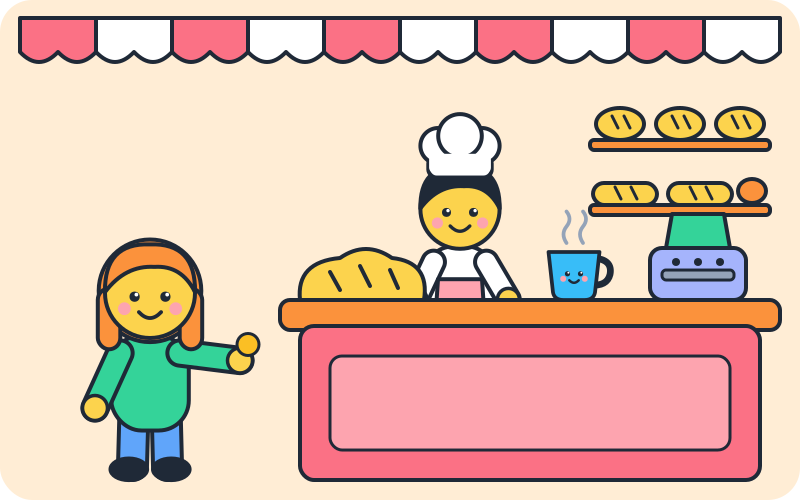
- .
- ?
The customer: me vê um pão (a roll, please). The baker: pois não? (what can I get you?). O pão (the bread), o café (the coffee), o caixa (the till).
| Who | Portuguese | English |
|---|---|---|
| attendant | ! ? | Morning! What can I get you? |
| you | ! . | Morning! A white coffee. |
| attendant | ? | Anything else? |
| you | . | A cheese bread too. |
| attendant | ? | To eat in or take away? |
| you | . , . | Take away. That's all. |
? sounds like "well, no?" but means "yes, how can I help?". , literally "for the journey", is takeaway; in speech is usually shortened to .
On the counter
| Portuguese | What it is |
|---|---|
cafezinho | small strong black coffee, often sweet |
| milky coffee, the breakfast standard |
| crusty white roll, the everyday bread |
| cheese bread ball from Minas Gerais |
| hot ham and cheese toastie |
coxinha | teardrop-shaped chicken croquette |
A coxinha is a salgado, one of the savoury snacks in the glass case. A fresh juice may come sweetened, so you may hear:
?- With sugar or without?
Quanto custa? Prices in reais
The verb agrees with what you are pricing:
| Pricing | Portuguese | English |
|---|---|---|
| one thing | ? | How much is the juice? |
| several | ? | How much are the rolls? |
| the total | ? | How much is it? |
| the total | ? | How much does it come to? |
The answer often skips the verb: . For a total you will also hear . - That comes to twenty .
Reais and centavos
Brazil's currency is the , plural , written R$. One hundred make a .
| Written | Said | Note |
|---|---|---|
| R$ 1,00 | | singular |
| R$ 2,00 | | , not |
| R$ 0,50 | | under a real |
| R$ 8,50 | | e joins the two |
| R$ 21,00 | | um, not |
Brazil writes a comma where English writes a decimal point, and R$ goes before the number. is masculine, so the numbers take their masculine forms: , . At a till people often drop the word : .
is expensive and cheap:
!- That's expensive!
Paying: a conta, o cartão, o troco
In a restaurant, catch the waiter's eye and ask:
, .- The bill, please.?- Can you bring the bill??- Can you close the bill? (very Brazilian)
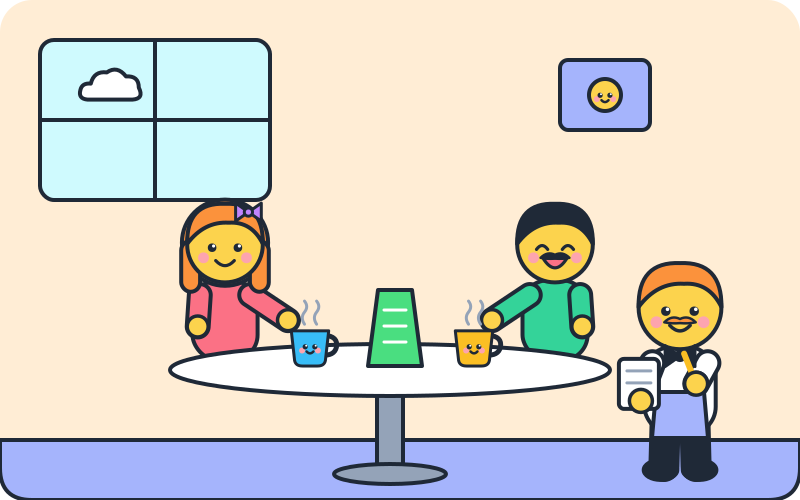
- , .
The customer asks: a conta, por favor (the bill, please). O garçom (the waiter), o cardápio (the menu), as xícaras (the cups).
A waiter is in Brazil and in . Restaurant bills often include an optional 10 per cent service charge, so check before tipping again. In a you usually pay at , the till, on the way out.
Card, cash or Pix
| How | Portuguese | English |
|---|---|---|
| card | . | I'll pay by card. |
| cash | . | I'll pay in cash. |
| Pix | Pix. | I'll pay by Pix. |
| you hear | Débito crédito? | Debit or credit? |
| you ask | ? | Do you take cards? |
Card and Pix take ; cash usually takes plain (casual Brazilian also says ). Débito crédito? comes almost every time, because one Brazilian card often does both. Answer in one word: Crédito.
is the change you get back. To leave it as a tip:
.- Keep the change.
Where are you from? Brasil, Portugal and português
A foreign accent at the counter often starts a short chat:
| Who | Portuguese | English |
|---|---|---|
| attendant | ? | Are you Brazilian? |
| you | , . | No, I'm English. |
| attendant | ? | Where are you from? |
| you | . . | I'm from England. From London. |
| you | . | I speak a little Portuguese. |
| attendant | ! | You speak very well! |
Brasil takes the article, Portugal does not
| Country | From | In |
|---|---|---|
| | |
| | |
| | |
takes an article, so and merge with it. So does in Brazil, though often says . takes no article anywhere, and neither do most cities:
.- I'm from..- She lives in London.
Nationality words
| Man | Woman | English |
|---|---|---|
| | Brazilian |
| inglesa | English |
| | Portuguese |
A woman says inglesa; a man says . The masculine loses its accent when -a is added. Nationalities and languages take a small letter: is both the language and a Portuguese man.
A café exchange, start to finish
Lunchtime at a lanchonete, one man, paying in cash:
| Who | Portuguese | English |
|---|---|---|
| waiter | ! ? | Afternoon! What will it be? |
| you | . | I'll have a toastie. |
| waiter | ? | And to drink? |
| you | , . | Orange juice, no sugar. |
| waiter | , ? | You're not from here, are you? |
| you | , . . | No, I'm English. I speak a bit. |
| you | ! , . | Thanks! The bill, please. |
| waiter | . | That's twenty-seven . |
| you | . , . | Cash. Here's thirty. |
| you | . | Keep the change. |
Brazil and Portugal: different words
| Brazil | Portugal | English |
|---|---|---|
| | menu |
| | juice |
| | breakfast |
| | waiter |
| | currency |
Mistakes English speakers make
| Wrong | Right | Why |
|---|---|---|
| is masculine | |
| real | | the plural is |
| R$ 8.50 | R$ 8,50 | Brazil writes a comma |
| . | . | takes o |
| do . | . | takes no article |
| . | . | nationalities are lowercase |
What to do next
- Order your next coffee in your head:
, . - Read three prices aloud from a receipt, with
and. - Do the drill below, then continue in the Portuguese course.