
Telling the Time in Portuguese: Que Horas São?
By Michael McGettrickUpdated 12 October 2026
Ask ? and answer . Minutes are added with e, and Brazil counts down to the next hour with :
Quick check
Three quick questions on what you have just read. The full practice is further down.
Pick the right one
0/3What time is it? Tap the clock time. Remember that para counts down to the next hour.
São duas e meia.
São quinze para as nove.
São dez para as três.
.- It's half past two..- It's quarter to nine.
The one grammar point to watch is the verb: é for one o'clock, for the rest.
The whole system on one screen
| Clock | Portuguese | Literally |
|---|---|---|
| 1:00 | . | it is one hour |
| 3:00 | . | they are three hours |
| 3:15 | . | three and fifteen |
| 3:30 | . | three and a half |
| 3:45 | . | fifteen to the four |
| 12:00 | . | it is midday |
| 0:00 | -. | it is midnight |
| at 3 | | at the three |
Two things do the work: against , and for the minutes before the hour. Everything else is numbers you already know.
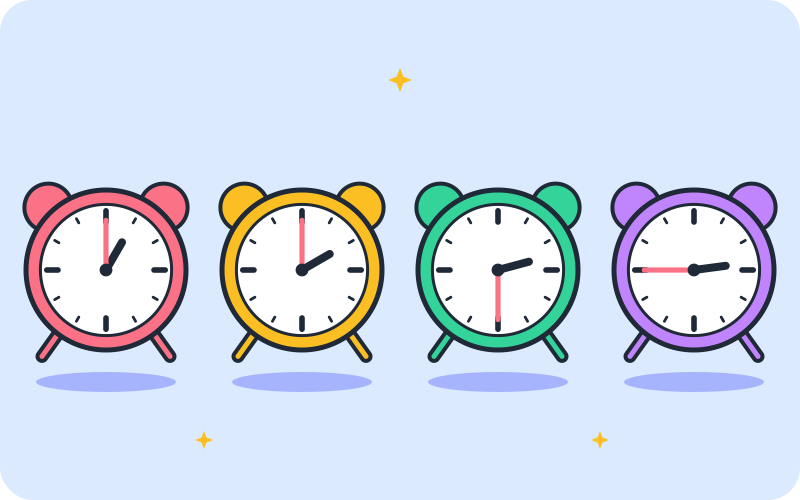
É uma hora (one o'clock), são duas horas (two o'clock), são duas e meia (half past two), são quinze para as três (quarter to three).
Asking the time: que horas são?
The question is plural, because it asks about hours: literally "what hours are they?".
| Portuguese | English | Note |
|---|---|---|
? | What time is it? | the standard form |
? | Do you have the time? | polite, to strangers |
. | It's three o'clock. | the full answer |
. | It's three. | just as common |
Or ?, do you know what time it is? Put (excuse me) in front when you stop someone in the street:
, ?- Excuse me, do you have the time?
Hora is feminine
One and two have feminine forms, so they agree with . Three to twenty do not change (twenty-one and twenty-two use and again: see the 24-hour clock below).
The same words measure a stretch of time, and context tells you which: . - I wait an hour.
É uma hora, são duas horas
The verb agrees with the number of hours. One is singular; two and above are plural.
| Clock | Portuguese | Verb |
|---|---|---|
| 1:00 | . | singular |
| 1:30 | . | singular |
| 1:50 | . | singular |
| 2:00 | . | plural |
| 6:00 | . | plural |
| 12:00 | . | plural |
The minutes never change the verb: 1:50 is still , because the hour is still one. Midday and midnight are single moments, so they take too:
.- It's midday.-.- It's midnight.
On the dot: em ponto
alone already means o'clock. To stress that it is exactly the hour, add :
.- It's eight o'clock on the dot..- The class starts at nine sharp.
Half and quarter: e meia, e quinze
After the hour, Portuguese adds the minutes with (and): hour first, then minutes.
| Clock | Portuguese | English |
|---|---|---|
| 4:05 | | five past four |
| 4:15 | | quarter past four |
| 4:20 | | twenty past four |
| 4:30 | | half past four |
| 4:40 | | twenty to five |
is short for , half an hour, so it is feminine and never changes, even after the masculine :
.- It's half past two..- It's half past twelve.
In Brazil the quarter hour is simply . You will rarely hear "quarter" on a Brazilian clock.
Portugal often counts in quarters
European Portuguese often uses , a quarter, where Brazil says . Both are correct; this course says the Brazilian forms.
| Clock | Brazil | Portugal |
|---|---|---|
| 2:15 | | |
| 8:45 | | |
| 8:45 | | |
| 2:30 | | |
To the hour: quinze para as nove
From about twenty to the hour, Brazilians count down to the next hour with : literally "fifteen to the nine".
| Clock | Portuguese | English |
|---|---|---|
| 8:40 | | twenty to nine |
| 8:45 | | quarter to nine |
| 2:50 | | ten to three |
| 12:55 | | five to one |
| 11:45 | | quarter to twelve |
The article after follows the next hour: for two upwards, for one, for midday.
.- It's quarter to nine..- It's ten to three. (literally: ten minutes are missing)
In quick speech shrinks to pras: pras . Write . Counting forward is never wrong either: is a perfectly good 8:45.
At what time? às três
"At" with a clock time is the preposition plus the article that stands for . Joined together, plus makes .
| Portuguese | English | Why |
|---|---|---|
? | At what time? | the question |
| at three | a + as |
| at half past eight | a + as |
| at one | a + a, singular |
| at midday | a + o, masculine |
- | at midnight | a + a, feminine |
In a sentence:
?- What time does the film start?.- The film starts at eight..- I'm arriving at half past one..- I have lunch at midday.
From one time to another, use plus the article, and for "around":
.- I work from nine to five..- I'll arrive around eight.
Midday, midnight and the parts of the day
(midday) is masculine and - (midnight) is feminine, which is why turns into between them. Both take the singular .
To say morning or evening after a clock time, add :
| After a time | English | Roughly |
|---|---|---|
| in the morning, am | until noon |
| in the afternoon, pm | noon to 6 |
| in the evening, pm | 6 to midnight |
madrugada | in the small hours | after midnight |
Without a clock time there is no : say and madrugada, but usually and (Brazil also says , ):
.- I work in the mornings.madrugada.- He arrived in the small hours..- I study in the evenings.
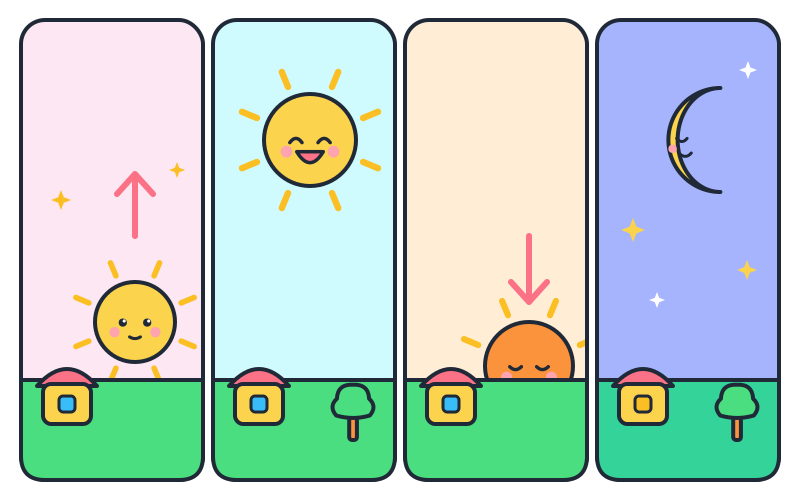
De manhã (in the morning), ao meio-dia (at midday), à noite (at night).
The 24-hour clock
Brazilian timetables, cinemas and official notices use the 24-hour clock, written 14h30 or 14:30. Read it as plain numbers: hour, , minutes.
| Written | Said |
|---|---|
| 13:00 | |
| 14:30 | |
| 16:45 | |
| 21:00 | |
| 22:10 | |
The hour is still feminine, so 21:00 is , not " ". and belong mainly to the 12-hour clock, so a timetable usually reads 14:30 as . Brazil also spells fourteen ; both spellings are correct.
.- The train leaves at 14:00.
In conversation most people switch back to the 12-hour clock: .
Mistakes English speakers make
| Wrong | Right | Why |
|---|---|---|
| . | . | one o'clock is singular |
| É . | . | two and up are plural |
| is feminine | |
| one is singular: a + a | |
| à | | is masculine |
| (at 3) | | at a clock time is |
is a real phrase, but it means within three hours, not at three o'clock.
What to do next
- Each time you check a clock today, say the time aloud,
orincluded. - Revise numbers and quantities, then add dates with days, months and time expressions.
- Do the drill below, then carry on with the Portuguese course.