
/fjuː/
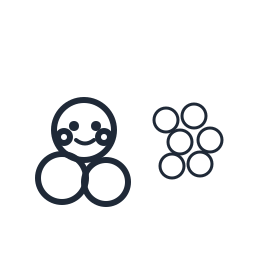
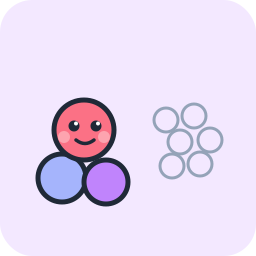
Translation
A small number of things or people; not many.
Word origin
Comes from the Old English word feawe, meaning a small number.
- Origin
- Old English
- Root
- feawe
Examples
.
"Few" shows the number of people was small.
.
Here "few" means a small number of books.
.
"Few" shows there are not many cars.
"Few" means a small number. You use it with things you can count, like people, books, or days. "A few" sounds friendly and means some, while "few" on its own can sound like not enough. The opposite is "many".
Where this fits
Used in
Stories
(5)Grammar articles
(23)Articles in English: a, an, the and the zero article
Compound nouns in English: car park, coffee cup, and why GREENhouse is not green HOUSE
Countable and uncountable nouns in English: advice, information, news and the ones you simply have to learn
This, That, These and Those: How to Point at Things in English
Ellipsis and substitution in English: I think so, neither do I, and the words you are allowed to leave out
English Greetings and Survival Phrases: Say Something Today
Hedging and vague language in English: sort of, a bit, -ish, stuff and or so
Modal verbs in English: rules, examples and how to use them
Past simple tense: rules, examples and when to use it
Phrasal-prepositional verbs: look forward to, put up with and the other three-part verbs
Phrasal Verbs with Get: 16 Meanings You Actually Need
Phrasal verbs in English: what they are, meanings, rules and examples
Prepositions in English: place, time and movement explained
Present continuous tense: form, spelling and uses
Present simple tense: rules, examples and when to use it
Quantifiers in English: some, any, much, many and more
Question tags in English: the mirror rule, aren't I, and tags after let's and imperatives
Reflexive and reciprocal pronouns in English: myself, yourself, each other, and when English does not bother
Reported speech in English: backshift, questions and commands
Separable and inseparable phrasal verbs: the rules that matter
The subjunctive and the unreal past in English: I suggest he go, if I were you, and it's time we left
Time clauses in English: when, while, as soon as, until, before and after
Word formation with prefixes: un-, in-, im-, dis-, re-, over-, under- and mis-
Add to review queue
Track this word in your spaced-repetition queue and be tested on it at the right interval.
Go to my review queueEnglish · Free printables
few: worksheet, infographic and listicle
Free printable study downloads for the English word "few" (A small number of things or people; not many.): a worksheet with the answer key built in, an infographic, and a sentence listicle. Open any one to view, print or save.
Free for members
The printable worksheets, infographics and PDFs are free with an account. Start a free week and download as many as you like.
Start your free weekThis word is part of lesson 7.