
/muːv/

Translation
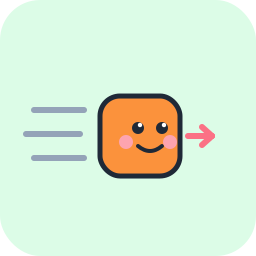
To move is to go from one place to another, or to put something in a new place.
Word origin
Move comes through French from a Latin word meaning to set in motion.
- Origin
- Latin
- Root
- movere
Grammar
Examples
.
Please put your car in a different place.
.
The train started to go forward.
.
We went to live in a different home.
To move is to change place - to go somewhere new or to shift a thing to another spot. We move our feet to walk and move boxes when we tidy up.
Where this fits
Used in
Stories
(17)Lost in Town
3 min read · Core 1000
Sports Day
3 min read · Core 1000
The New Neighbour
3 min read · Core 1000
The Phone Call
3 min read · Core 1000
One Sheep Short
4 min read · Core 5000
The Boat in the Garden
4 min read · Core 5000
The Broken Window
4 min read · Core 5000
The Letter She Never Sent
4 min read · Core 5000
The Long Way Home
4 min read · Core 1000
The Passenger
4 min read · Core 5000
The Box in the Wood
5 min read · Core 5000
The First Letter
5 min read · Core 5000
The Night Route
5 min read · Core 5000
The Suggestion Box
5 min read · Core 5000
The Whale on the Beach
5 min read · Core 5000
Two Tickets to Paris
5 min read · Core 5000
The Last Light
8 min read · Core 5000
Grammar articles
(20)Adjective order in English: opinion, size, age, shape, colour, origin, material, purpose
Adverb position in English: before the verb, after be, and the just, still and already traps
Cleft sentences in English: it was X who, what I need is, and how to move the emphasis
Countable and uncountable nouns in English: advice, information, news and the ones you simply have to learn
Ellipsis and substitution in English: I think so, neither do I, and the words you are allowed to leave out
Future in the past: was going to, would, was about to, and the grammar of plans that failed
Gerund and infinitive: which verb form comes next?
Indirect questions in English: Could you tell me where the station is, and the word order that goes with it
Inversion and word order in English: the subject-verb-object spine and when it flips
Nominalisation in English: arrive becomes arrival, decide becomes decision, and why written English turns actions into things
Advanced passive structures in English: the get-passive, it is said that, and passives with two objects
Past perfect tense: had plus past participle, and when English actually needs it
Phrasal-prepositional verbs: look forward to, put up with and the other three-part verbs
Phrasal Verbs with Get: 16 Meanings You Actually Need
Phrasal Verbs with Put: 13 Meanings You Actually Need
Reported speech in English: backshift, questions and commands
The subjunctive and the unreal past in English: I suggest he go, if I were you, and it's time we left
Time clauses in English: when, while, as soon as, until, before and after
Verb patterns with objects in English: want somebody to do, make somebody do, and see somebody doing
Word formation in English: how suffixes build word families and give away the part of speech
Add to review queue
Track this word in your spaced-repetition queue and be tested on it at the right interval.
Go to my review queueEnglish · Free printables
move: worksheet, infographic and listicle
Free printable study downloads for the English word "move" (To move is to go from one place to another, or to put something in a new place.): a worksheet with the answer key built in, an infographic, and a sentence listicle. Open any one to view, print or save.
Free for members
The printable worksheets, infographics and PDFs are free with an account. Start a free week and download as many as you like.
Start your free weekThis word is part of lesson 4.