
Ch 4 · Lesson 25French · Chapter 4 · Lesson 25 · Grammar primer
Days of the week: lundi or le lundi?
to , all lower case, and the split English does not make: is this Monday, every Monday.
The short version
is every Monday, not this one
, .
Why?Hide
English says on Monday for one Monday and for every Monday. French splits them: alone is one specific Monday, usually the next, while is the weekly habit. Say about this week's plans and you have just promised to turn up every week.
French days and months are lower case, all masculine, and mostly easy to recognise. Dates are simpler than in English: 14 is the 14th of July, with no "th" and no "of". The one exception is the 1st, .
The whole system on one screen
| You want to say | French | Note |
|---|---|---|
| on Monday (this) | | one specific Monday |
| on Mondays | | every week |
| in May | | all months take |
| in spring | | the only season with |
| in summer | | also , |
| the 3rd of May | | a plain number |
| the 1st of May | | the only ordinal |
| in 2026 | - | years take |
Each row is one section below.
Days of the week
The French week starts on Monday, and calendars print it that way. All seven days are masculine and written in lower case.
| French | English |
|---|---|
| Monday |
| Tuesday |
| Wednesday |
| Thursday |
| Friday |
| Saturday |
| Sunday |
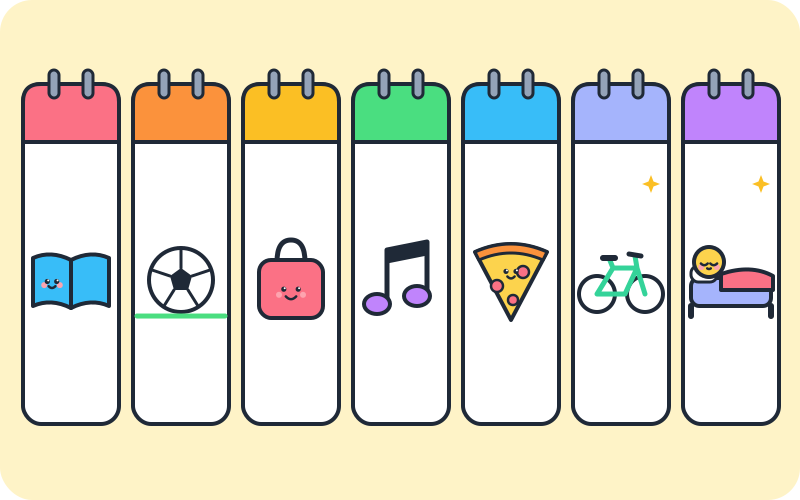
Lundi to dimanche, Monday first, all lower case. The book on lundi is the school or work week starting; dimanche is the lie-in.
Five of the names come from the sky: is the moon's day, 's, Mercury's, Jupiter's, 's. The -di is the Latin for day.
lundi or le lundi?
English says "on" for both a single Monday and every Monday. French splits them.
| English | French |
|---|---|
| I'm working Monday. | , . |
| I work on Mondays. | , . |
| On Sundays we're in. | , . |
No article means one Monday, normally the next one. means the habit, every week. There is never a word for "on": not , not .
Next, last and every
| French | English |
|---|---|
| next Monday |
| last Monday |
| this Monday |
| every Monday |
Days take a plural like any other noun: . It means the same as , said louder.
Asking what day it is
- ?- What day is it? (standard)?- What day is it? (everyday speech).- It's Monday..- It's Monday. (just as common)
is also correct, a touch more formal.
Going further: Months of the year and the rest of the guide, when you want them. This lesson does not need them.
Practice
Practise this lesson
8-question session
One question at a time, mixed across the exercises in this lesson. Miss one and it comes back round before the end.
New words in this lesson
 le lundi(masculine)/lœ̃.di/Monday
 le mardi(masculine)/maʁ.di/Tuesday
 le mercredi(masculine)/mɛʁ.kʁə.di/Wednesday
 le jeudi(masculine)/ʒø.di/Thursday
 le vendredi(masculine)/vɑ̃.dʁə.di/Friday
 le samedi(masculine)/sam.di/Saturday
 le dimanche(masculine)/di.mɑ̃ʃ/Sunday
 la semaine(feminine)/sə.mɛn/week
 aujourd'hui/oʒuʁdɥi/today
French · Free printables
Worksheets for this lesson
Worksheets with answer keys built in. Open any one to view, print or save.
Free for members
The printable worksheets, infographics and PDFs are free with an account. Start a free week and download as many as you like.
Start your free weekLesson 25 of 31 in this chapter