
Italian Passato Prossimo: How to Form and Use the Everyday Past
By Michael McGettrickUpdated 12 October 2026
The is the past Italians speak: a present form of or , plus a past participle. - I ate. - I went. Choose the right helper verb and the rest is regular.
Quick check
Three quick questions on what you have just read. The full practice is further down.
Spot the mistake
0/3Tap the mistake.
The whole system on one screen
| Piece | Example | English |
|---|---|---|
| + participle | | I spoke, I have spoken |
| + participle | | I went (a man) |
| : it agrees | | I went (a woman) |
| -are, -ere, -ire | | spoken, had, slept |
| the irregular few | | done, seen, said |
Most verbs take . Going, coming, staying and changing take , and then the ending agrees with the subject.
How the passato prossimo is built
The helper verb changes for the person. The participle carries the meaning:
| Person | parlare | andare |
|---|---|---|
| | , |
| | , |
| | , |
| | , |
| | , |
| | , |
Read down each column. With only the helper moves, and stays the same for everyone. With the participle also changes its ending, exactly like an adjective:
Marco .- Marco went home.Anna .- Anna went home.
If and are not yet automatic in the present, fix that first on essere and avere.
The participle: -ato, -uto, -ito
A regular participle swaps the infinitive ending for one of three:
| Infinitive | Participle | Example |
|---|---|---|
| | Marco. - I spoke to Marco. |
| | . - I had an idea. |
| | . - I slept well. |
| | . - I understood. I get it. |
The verbs you use most are the irregular ones, and many of them end in -tto, -sto or -so:
| Infinitive | Participle | Example |
|---|---|---|
| | ? - What did you do? |
| | ? - What did you say? |
| | Anna. - I saw Anna. |
| | . - I had a coffee. |
| | ? - Where did you put the book? |
| | . - I wrote a letter. |
| | . - I read the book. |
| | . - I opened the door. |
| | Roma. - I have been to Rome. |
The full set is on Italian past participles.
Essere or avere: the rule that actually works
goes with every verb that can take a direct object, even when it has none in this sentence:
.- I ate..- I ate the pizza.
goes with verbs where the subject itself goes, arrives, stays or changes, and nothing is done to anything else:
| Verb | Meaning | Passato prossimo |
|---|---|---|
| to go | |
| to come | |
| to arrive | |
| to leave | |
| to go out | |
| to go in | |
| to come back | |
| to stay | |
| to become | |
| to be born | |
| to die | |
- .
- .
- .
- .
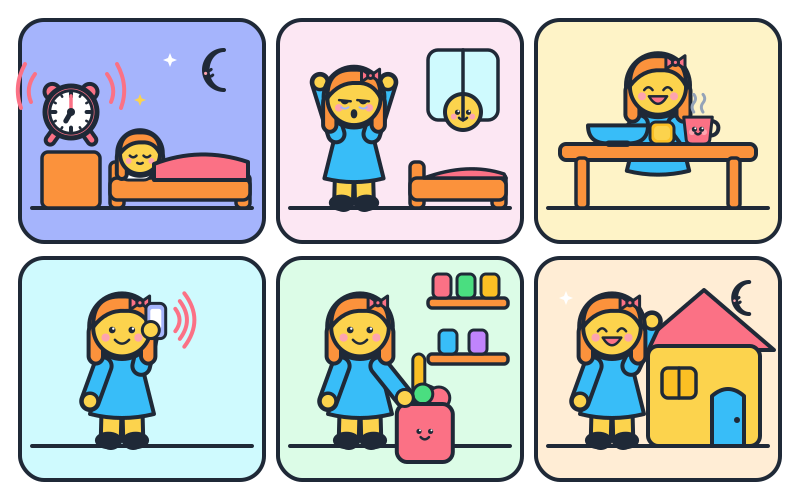
Ha fatto colazione: she had breakfast. Ha telefonato: she made a phone call. È andata a fare la spesa: she went shopping. È tornata a casa: she came home. Doing takes avere; going and coming take essere.
Three more groups take :
| Group | Example | English |
|---|---|---|
| Roma. | I' been to Rome. |
| reflexive verbs | . | I got up early. |
| happening, pleasing | ? | What happened? |
| happening, pleasing | . | I liked it. |
The test for a new verb: could it do something to something? If yes, . Most other verbs take too, even with no object, because sleeping, phoning and walking are activities rather than trips somewhere:
.- I slept well..- I walked a lot..- I travelled by train.
A handful of verbs with no object take without being trips, such as and : ? - How much did it cost? A good dictionary marks the helper for each verb.
With essere, the participle agrees
The ending matches the subject, like an adjective:
| Subject | Passato prossimo | English |
|---|---|---|
Marco | | Marco came back. |
Anna | | Anna came back. |
| | The boys came back. |
| | The girls came back. |
A mixed group takes -i. A woman talking about herself says , every time. With nothing agrees:
Anna .- Anna ate.
Verbs that take both
A few verbs take with an object and without one:
| Verb | Object: avere | No object: essere |
|---|---|---|
| . | . |
| . | . |
| . | . |
| . | . |
In order: I finished the work, the film has finished; I started the book, the lesson has started; I had a lovely day, time has passed; I moved house, everything has changed. The helper tells you whether someone did it or it simply happened.
Agreement with a pronoun: l'ho vista
One case where agrees: a direct object pronoun (, , , ) in front of the verb. The participle then agrees with the pronoun:
Maria? .- Maria? I saw her.? .- The books?read them.? .- The keys? I took them.
and shorten to ' before the helper. More on Italian object pronouns.
Modal verbs in the past
, and take on their own. With an infinitive after them, careful Italian borrows the infinitive's helper:
| Infinitive takes | Example | English |
|---|---|---|
. | I had to work. | |
. | I had to leave. | |
Anna . | Anna couldn't come. |
Both are correct. is very common in speech; careful writing tends to prefer , with the participle agreeing.
Where già and mai go
Short adverbs of time sit between the helper and the participle. goes in front of the helper:
.- I have already eaten..- I have never seen the sea..- I have just arrived..- I haven't finished yet.
sits in the same gap: , I have always lived here.
When to use it
Use the for anything that happened and is finished, a second ago or years back:

- .
- .
Ieri ho giocato a calcio: yesterday I played football, finished, so passato prossimo. Oggi leggo: today I'm reading, the present.
.- Yesterday I saw my brother.?- Have you eaten?.- Last year I went to.
It translates both I saw and I have seen. English refuses yesterday I have seen; Italian puts with the all the time. Ask one question: is it finished?
Background, habits and things in progress (it was raining, I used to live there) belong to the imperfetto; choosing between the two is passato prossimo vs imperfetto. Books also use a second past, the remoto (, ): recognise it, but speak in the .
Mistakes English speakers make
| Wrong | Right | Why |
|---|---|---|
| ho | | going takes |
| ho | | is its own helper |
| (woman) | | with , the ending agrees |
| Anna ha . | Anna . | with , no agreement |
| Ho . | . | goes before the helper |
| ho (still) | . | still going on: present + |
What to do next
The with and , and its agreement, are on the Pearson Edexcel GCSE Italian specification at Foundation and Higher tier.
- Learn each new verb with its past:
,, - Say five things you did yesterday, starting
.... - Next: Italian past participles, the irregular ones in full.