
Italian School and Town Words: a scuola, in piazza, Scusi, dov'è...?
By Michael McGettrickUpdated 12 October 2026
School and town is mostly words, and many are close to English. Two things need learning on top: the form for a woman, , and the small word before a place: , but .
Quick check
Three quick questions on what you have just read. The full practice is further down.
Spot the mistake
0/3Tap the mistake.
The whole system on one screen
| Italian | English |
|---|---|
| the teacher, a woman ( : a man) |
| the student, a woman ( : a man) |
| the teacher, a man or a woman |
| at school, to school: no article |
| at or to the cinema: a + the article |
, ...? | Excuse me, where is...? |
| straight on |
, | on the right, on the left |
At school: il professore, la professoressa
 the book
 the exercise book
 the pen
 the school bag
| Italian | English |
|---|---|
| school |
| the class, the classroom |
| the lesson |
| a piece of homework |
| the test (in class) |
| the exam |
| the mark |
| the page |
| the pupil |
Pupils call a secondary teacher Prof, or , and use , not the first name. Homework is plural:
.- I'm doing my homework.
School subjects
| Italian | English | Italian | English |
|---|---|---|---|
| Italian | | history |
| English | | geography |
| maths | | science |
| music | | art |
A subject is :
.- My favourite subject is history..- I'm studying Italian. (?- Do you speak English? (with, no article)
People: a form for a woman
Three patterns cover nearly every word for a person:
| Pattern | Man | Woman |
|---|---|---|
| -o to -a | | alunna |
| add -essa | | |
| add -essa | | |
| one for both | | |
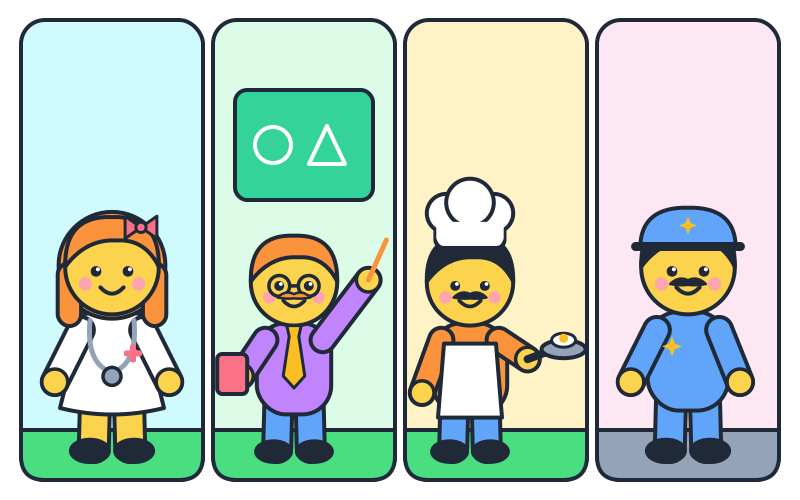
La dottoressa: the doctor, a woman (il dottore for a man). Il professore: the teacher. Il cuoco: the cook. Il poliziotto: the police officer.
Most words in -ante and -ente keep one form, and only the article changes: , , . is an exception: it takes -essa. Words in -ore often take -essa or -trice: learn those one at a time.
Around town: piazza, stazione, museo
 the square
 the church
 the museum
 the station
| Italian | English | Italian | English |
|---|---|---|---|
| the centre | | the stop |
| the cinema | | the bus |
| the library | | the train |
| the park | | the ticket |
| the supermarket | | the bank |
| the baker's | | the chemist's |
| the tower | | the hospital |
| the bridge | | the block of flats |
is the heart of an Italian town: the bar, the church and the town hall are there, and people meet there in the evening. and never change in the plural:
Where I live
.- I live in the centre..- I live on the outskirts..- I live in a block of flats with a lift..- My area is lively.
Most Italians in a town live in a flat. is any large building; it is a palace only when it is a grand historic one.
A scuola, al cinema: where you are and where you go
The same words say being somewhere and going there: is at school and to school. The choice is a bare preposition, or with the article:
| No article | a + the article |
|---|---|
| |
| |
| |
| |
| |
| |
.- I go to school by bus..- I study at the library..- Tonight we'going to the cinema..- See you at the station. (
Towns take , countries , and transport , except on foot:
Bologna.- I live in Bologna..- I live in Italy., .- I go to school by bus, or on foot.
Asking the way: Scusi, dov'è...?
To a stranger, start with , the polite excuse me. To a friend it is .
, ?- Excuse me, where is the station?, ?- Excuse me, is there a chemist's near here??- Is it far?
| You hear | It means |
|---|---|
. | Go straight on. |
. | Turn right. |
. | Turn left. |
| at the corner |
| at the traffic lights |
| at the crossroads |
| near the square |
. | It's five minutes away. |
and are polite commands, the form a stranger uses with you. A map is .
Free time: calcio, sport, videogiochi
.- I play football..- I play video games..- I do sport..- I go to the gym..- I'll take you to the cinema (my treat)..- My friend is nice.
Games take : , . is the word for a nice, likeable person, and one of the first things Italians say about someone.
A first day: a short scene
, Sam. .- Hi, I'm Sam. I'm new.Sam! Giulia.- Hi Sam! I'm Giulia.?- Who's the maths teacher?Ferraro. , .- Ms Ferraro. She's strict, but nice.?- And where's the library?, .- Straight on, then right.. ?- After school we'going to the square. Coming?
Mistakes English speakers make
| Wrong | Right | Why |
|---|---|---|
| professora | | takes -essa |
| (daily) | . | school takes no article |
| a cinema. | . | the cinema takes the article |
| in Bologna. | Bologna. | towns take a |
| . | . | games take a |
| due autobusi | | never changes |
| (stranger) | | to strangers |
is not impossible: it points at one particular school building ( , to my daughter's school). For school as a routine, it is .
What to do next
- Say where you are going today with
,or:.... - Ask the way to three places in your own town:
, ...?. - Next: articulated prepositions, where
andcome from.