
Ch 33 · Lesson 17Spanish · Chapter 33 · Lesson 17 · Grammar primer
The gerund (-ndo): salió corriendo, aprendo escuchando
The gerund is an adverb: how ( ), by what means ( ), at the same time, and still or gradually with and .
The short version
The gerund is an adverb, not a noun
.
Why?Hide
Spanish -ando and -iendo describe how or by what means another action happens: , . What it never does is the noun jobs English hands to -ing. It cannot be a subject ( ), it cannot follow a preposition ( ), and it rarely describes a noun ( ).
Ran out is
.
Why?Hide
English puts the manner in the verb and the direction in a little word: ran out, swam across. Spanish usually flips it. The direction is the verb and the manner is a gerund: , , .
The gerund at a glance
The whole page on one screen. The first four rows are the gerund's real jobs; the last three are English -ing jobs it cannot do.
| Job | Spanish | English |
|---|---|---|
| how (manner) | . | He/She ran out. |
| by what means | . | I learn by listening to music. |
| at the same time | . | I have breakfast reading the news. |
| still, gradually | . | It's still raining. |
| a subject | . | Smoking is bad. |
| after a preposition | | before leaving |
| describing a noun | | a box containing books |
One test covers most cases: if the English -ing means "by doing" or "while doing", use the gerund. If you could put "the" in front of it, or a preposition sits before it, use the infinitive.
Forming the gerund
Add - to -ar verbs and -iendo to -er and -ir verbs. Two groups change:
| Verb | Gerund | Why |
|---|---|---|
| | -ar: - |
| | -er: -iendo |
| | -: -iendo |
| | a vowel before: - |
| | a vowel before: - |
| | -: e becomes i |
| | -: e becomes i |
| | -: o becomes u |
| | irregular |
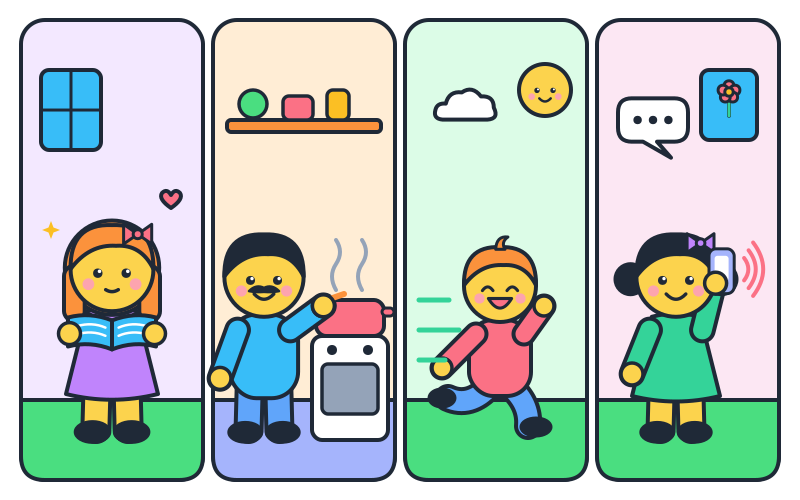
Leyendo (reading), cocinando (cooking), corriendo (running), hablando por teléfono (talking on the phone). The gerund never changes for gender or number.
The gerund never agrees: , . Pronouns join its end, with an accent to keep the stress: . - He/She left saying goodbye.
How: the gerund of manner
After a verb of movement or speaking, the gerund says how it happened:
| Verb | Spanish | English |
|---|---|---|
| go out | . | He/She ran out. |
| arrive | . | He/She arrived singing. |
| come in | . | He/She came in shouting. |
| answer | . | He/She answered with a smile. |
| cross | . | He/She swam across the river. |
| go up | . | He/She ran upstairs. |
English puts the manner in the verb and the direction in a little word: ran out, swam across. Spanish usually does the opposite. The direction is the verb (, , ) and the manner is the gerund.
By what means, and at the same time
The gerund also answers by what means?, where English says "by doing":
.- I learn by listening to music..- He got rich by working hard..- He/She passed the exam by studying every night.
And it adds a second action going on at the same time, by the same person:
.- I have breakfast reading the news..- The baby fell asleep crying., Ana.- Walking through the park, I saw Ana.
At the start of a sentence it can also mean "if": , . - If we leave now, we'll get there in time.
Still and gradually: seguir and ir
A few helper verbs take the gerund to say an action is still going or building up slowly:
.- It's still raining..- It's gradually getting better..- He/She's going around looking for work.
These are verbal periphrases; the whole set, with for "have been doing", is on the verbal periphrases page. + gerund, the present progressive, has its own page.
Going further: Trap 1: a subject or an activity is the infinitive and the rest of the guide, when you want them. This lesson does not need them.
Practice
Practise this lesson
10-question session
One question at a time, mixed across the exercises in this lesson. Miss one and it comes back round before the end.
Spanish · Free printables
Worksheets for this lesson
Worksheets with answer keys built in. Open any one to view, print or save.
Free for members
The printable worksheets, infographics and PDFs are free with an account. Start a free week and download as many as you like.
Start your free weekLesson 17 of 27 in this chapter