
Ch 39 · Lesson 8Spanish · Chapter 39 · Lesson 8 · Grammar primer
Compound prepositions of place: delante de, encima de
, , : the is never optional, a pronoun after it is the strong form ( ), and , and are the one-word twins ( and more formal).
The short version
The is not optional
.
Why?Hide
Most Spanish place prepositions are really adverbs bolted onto a noun with , and the is compulsory. , , . Drop it and the phrase collapses. With a pronoun the stays and pulls in the accented strong form, so it is (with the accent), not .
is under;
.
Why?Hide
For a cat under a table, say . is one word, more formal, and also covers the cases where nothing is physically on top: (in the rain), , .
A compound preposition is a word plus or a working as one preposition. The is never optional, and a pronoun after it is the strong form:
.- The car is in front of the house..- He/She sat in front of me.
Place: the de family
, and are adverbs. On their own they say where, with no noun:
.- The car is in front..- The car is in front of the house.
To name the thing, add . Drop it and the phrase is wrong: never .
| Spanish | English |
|---|---|
| in front of the door |
| behind the house |
| on top of the table |
| under the bed |
| inside the box |
| away from home |
| near the beach |
| far from the city |
| next to the house |
| around the table |
| opposite my house |
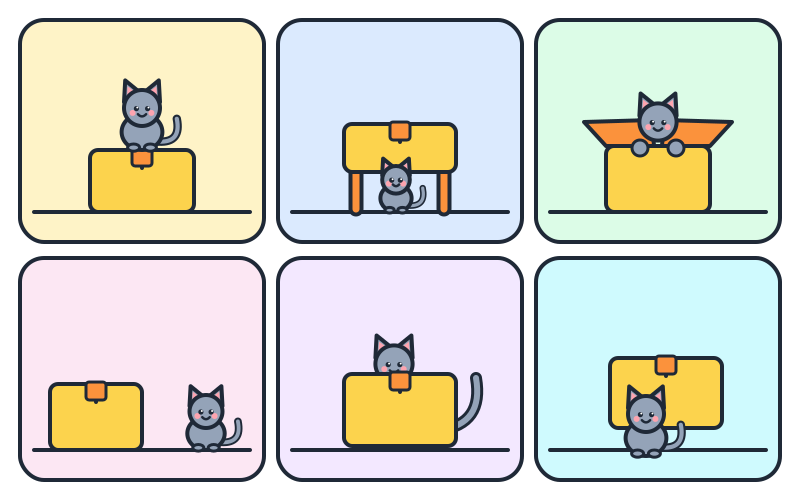
Encima de la caja (on top of the box), debajo de la caja (under the box), dentro de la caja (inside the box), al lado de la caja (next to the box), detrás de la caja (behind the box), delante de la caja (in front of the box).
and merge into , as they do everywhere:
.- I live near the centre.
Two that take a: junto a, frente a
.- He/She sat right by the window..- The hotel faces the sea.
With a pronoun: delante de mí
After the the strong pronoun, the same one as after any preposition. Only and differ from the subject pronouns:
| Person | Spanish | English |
|---|---|---|
| me | | in front of me |
| you | | behind you |
| him | | near him |
| her | | next to her |
| us | | far from us |
| them | | around them |
carries an accent; without it means my. In speech you will hear and , but the RAE advises against them in careful Spanish. Write .
The two that take a work the same way: - right next to me.
Under, on, behind: bajo, sobre, tras
Three short prepositions shadow the compounds. and are more formal ( is everyday too), and they also cover abstract cases where the compound would be wrong:
| Compound | One word | Example |
|---|---|---|
- under the table (formal) | ||
| (none) | - in the rain | |
| (none) | - under control | |
- on the table | ||
- a book about the war | ||
- behind the door (written) | ||
- after the meeting | ||
| (none) | - day after day |
For a cat under a table, say . After another preposition, only works:
.- The cat came out from under the bed.
, and can all mean on. is the everyday choice; stresses on top of it.
Delante de or enfrente de
is directly in front; is opposite, across a street or a room:
.- The taxi is outside the hotel..- The chemist's is opposite the hotel.
Going further: Compound prepositions at a glance and the rest of the guide, when you want them. This lesson does not need them.
Practice
Practise this lesson
10-question session
One question at a time, mixed across the exercises in this lesson. Miss one and it comes back round before the end.
Spanish · Free printables
Worksheets for this lesson
Worksheets with answer keys built in. Open any one to view, print or save.
Free for members
The printable worksheets, infographics and PDFs are free with an account. Start a free week and download as many as you like.
Start your free weekLesson 8 of 29 in this chapter