
Ch 2 · Lesson 14English · Chapter 2 · Lesson 14 · Grammar primer
Sit down, come in, don't stop: the imperative
To tell someone what to do, use the verb alone: Wait. Come here. To say no, put don't in front: Don't stop.
The short version
The imperative is just the base verb
, Tom!
Why?Hide
To tell someone what to do, start with the base verb: no you, no -s, no to. The form is the same for one person or a whole room. To say not to do something, put don't in front of the verb. It is always don't, for everyone.
The imperative tells someone what to do. It is the easiest form in English: just the base verb, with no you and no ending. Sit down. (I want you to sit.)
| What you want | Pattern | Example |
|---|---|---|
| verb | . | |
| + verb | ! | |
. | ||
| + verb | . |
The base verb, nothing else
Start the sentence with the base verb. That is all.
| Base verb | Imperative | What it says |
|---|---|---|
. | ||
. | ||
. | ||
. | ||
! | ||
. |
- .
- .
- .
- .
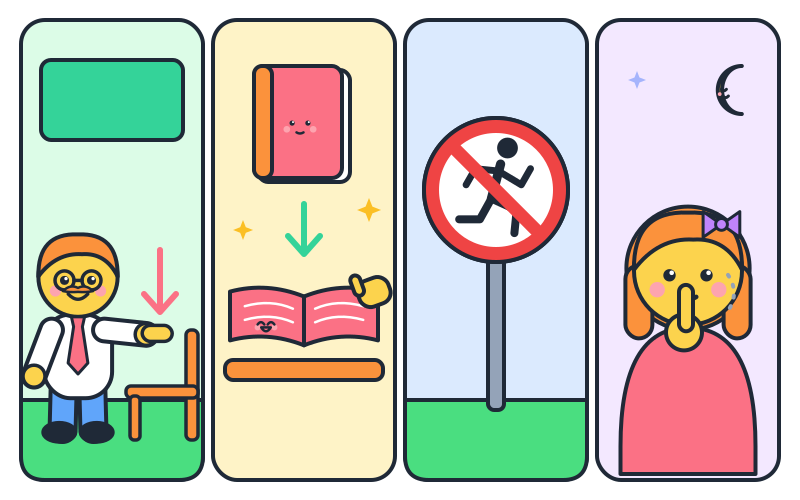
Classroom orders: the base verb, nothing else. For not, put don't first.
The form is the same for one person or many:
, Tom.(one person), .(the whole room)
There is no -s, no -ing and no to:
A name can go at the start or the end: Tom, come here. Come here, Tom. (the same command, said to Tom).
Don't for a negative
To tell someone not to do something, put don't before the base verb.
| Positive | Negative |
|---|---|
. | . |
. | . |
. | . |
. | . |
It is always don't, for everyone:
, Tom!(not Doesn't run).(not Not be late)
On signs you often see the long form: Do not enter. (you cannot go in). Never makes a strong rule: Never open this door. (not one time, ever).
Going further: Please makes it polite and the rest of the guide, when you want them. This lesson does not need them.
Practice
Practise this lesson
7-question session
One question at a time, mixed across the exercises in this lesson. Miss one and it comes back round before the end.
English · Free printables
Worksheets for this lesson
Worksheets with answer keys built in. Open any one to view, print or save.
Lesson 14 of 37 in this chapter