
Ch 5 · Lesson 16French · Chapter 5 · Lesson 16 · Grammar primer
Je voudrais un café: ordering politely
, not : the one chunk that makes any order polite. , , and .
The short version
Order with , not
, .
Why?Hide
To order in French, (I would like) in front of what you want and finish with . means I want: correct French, but it sounds blunt to a waiter, the way I want a coffee does in English. Learn as one fixed chunk and use it everywhere.
To order in French, say (I would like), the thing, and . Not , which is I want and sounds blunt. To ask the price, say ? Prices come euros first, then cents. And the bill is .
That is the whole lesson on one screen:
| You want to... | Say | English |
|---|---|---|
| ask for something | , . | I'd like a coffee, please. |
| order in a hurry | , . | A coffee, please. |
| ask the price | ? | How much is it? |
| ask for the total | ? | How much is that? |
| understand a price | . | €2.50 |
| pay at a table | , . | The bill, please. |
And before any of it: . Ordering at a counter without a hello is the one thing that reliably earns you a cold look in France.
Je voudrais: the polite way to ask
means I would like. Learn it as one block that you put in front of whatever you want. Add a noun and , and you have a complete, polite order.
, .- I'd like a coffee, please., .- I'd like a, please., .- I'd like some water, please.
Notice , some water: French puts a word for "some" in front of things you cannot count, the partitive.
also takes a verb in the infinitive, the dictionary form:
.- I'd like to pay..- I'd like to eat.
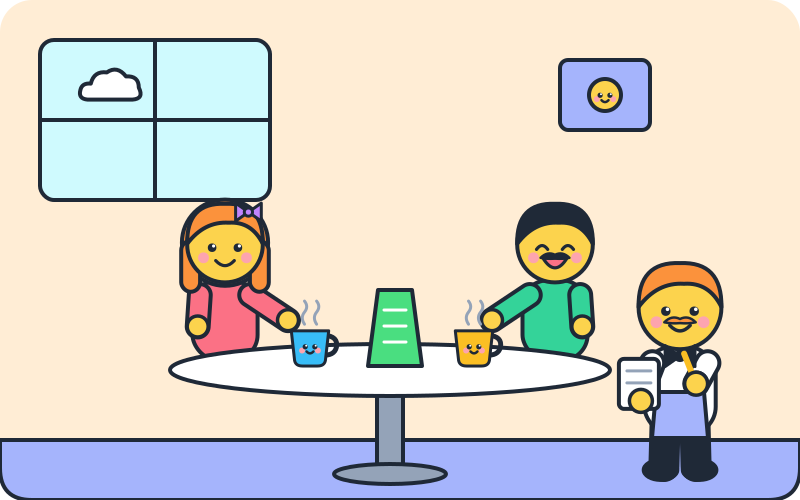
At the table: la cliente and le client (the customers), le serveur (the waiter), la carte (the menu) and deux cafés (two coffees). Each customer orders with je voudrais.
Why not je veux?
is I want. It is correct French, and with friends it is fine:
.- I want a coffee. (blunt to a waiter).- I'd like a coffee. (polite)
Said to a waiter, lands the way "I want a coffee" lands in English: the grammar is right and the manners are not.
Strictly, is (to want) in the conditional, but you do not need the tense to use the chunk. is on the AQA GCSE French specification at Foundation and Higher tier.
Other ways to ask
is the safe default, but it is not the only way. Here is what you will hear at a table, from blunt to careful:
- Je veux un café.fine with friends only
- Je prends un café.choosing from the menu
- Un café, s’il vous plaît.after bonjour, perfectly polite
- Je voudrais un café.safe everywhere
| Register | Phrase | English |
|---|---|---|
| everyday | , . | A coffee, please. |
| everyday | , . | A tea for me. |
| everyday | . | I'll have a beer. |
| polite | . | I'd like a glass of wine. |
| blunt | . | I want a coffee. |
is what you say when the waiter goes round the table: each person names their order with "for me" in front. , I'll have, is what the French very often say when choosing from a menu:
.- I'll have the fish.
The bare noun plus is not rude. At a busy counter it is exactly what everyone says, provided the came first.
Going further: C'est combien ? Asking the price and the rest of the guide, when you want them. This lesson does not need them.
Practice
Practise this lesson
9-question session
One question at a time, mixed across the exercises in this lesson. Miss one and it comes back round before the end.
New words in this lesson
- l'euro(masculine)/ø.ʁo/euro
- le centime(masculine)/sɑ̃.tim/cent (one hundredth of a euro), centime
 le prix(masculine)/pʁi/price; prize
 coûter/ku.te/to cost
- l'addition(feminine)/a.di.sjɔ̃/bill (in a restaurant); addition, sum
 le café(masculine)/ka.fe/coffee; cafe
 le thé(masculine)/te/tea
 l'eau(feminine)/o/water
 le vin(masculine)vɛ̃wine
 le verre(masculine)/vɛʁ/glass (drinking glass or material)
 la bière(feminine)bjɛʁbeer
- la baguette(feminine)/ba.ɡɛt/baguette; stick, wand, chopstick
French · Free printables
Worksheets for this lesson
Worksheets with answer keys built in. Open any one to view, print or save.
Free for members
The printable worksheets, infographics and PDFs are free with an account. Start a free week and download as many as you like.
Start your free weekLesson 16 of 32 in this chapter