
/maʁʃe/
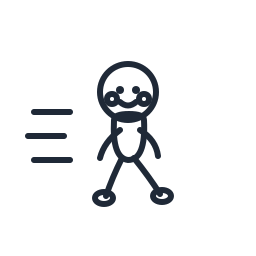

Translation
to walk; to work, to function
Word origin
From Old French marchier ('to tread, to march'), of disputed origin. It may go back to Frankish markon ('to mark out, to tread') or to Latin marcus ('hammer').
- Origin
- Old French
- Root
- marchier
- English cognates
- march
Other proposed origins
- Often traced to Frankish markon ('to mark out, to press with the foot'). (markon)
- Some accounts derive it from Latin marcus ('hammer'), via a sense of beating the ground. (marcus)
Grammar
Conjugation
Regular -er conjugation. Pronouns: je, tu, il/elle, nous, vous, ils/elles.
Indicative
| Person | Present | Imperfect | Past historic | Future | Conditional |
|---|---|---|---|---|---|
| je | marche | marchais | marchai | marcherai | marcherais |
| tu | marches | marchais | marchas | marcheras | marcherais |
| il/elle | marche | marchait | marcha | marchera | marcherait |
| nous | marchons | marchions | marchâmes | marcherons | marcherions |
| vous | marchez | marchiez | marchâtes | marcherez | marcheriez |
| ils/elles | marchent | marchaient | marchèrent | marcheront | marcheraient |
Subjunctive
| Person | Present | Imperfect |
|---|---|---|
| je | marche | marchasse |
| tu | marches | marchasses |
| il/elle | marche | marchât |
| nous | marchions | marchassions |
| vous | marchiez | marchassiez |
| ils/elles | marchent | marchassent |
Imperative
| Person | Affirmative |
|---|---|
| tu | marche |
| nous | marchons |
| vous | marchez |
Non-finite
- Gerund / present participle
- marchant
- Past participle
- marché · marchée · marchés · marchées
Examples
au .
It is about a twenty-minute walk from the station to the office.
- ' ?
Is the television still working after yesterday's breakdown?
cette .
That is not how things work in this company.
.
We walked for three hours in the countryside.
.
This old phone has not been working since yesterday.
est un verbe regulier du premier groupe avec deux sens principaux : marcher (to walk) et marcher (to work, to function - said of objects or plans). Ca marche ! (It works! / OK!) est une des expressions les plus frequentes du francais oral.
Faire marcher quelqu'un (to make someone look a fool, to pull someone's leg) est une expression de plaisanterie. Marcher sur des oeufs (to walk on eggshells) signifie agir avec prudence extreme. Marcher a pied est pleonastique mais parfois utilise pour insister sur le moyen de transport.
Where this fits
Used in
Stories
(5)Grammar articles
(1)Add to review queue
Track this word in your spaced-repetition queue and be tested on it at the right interval.
Go to my review queueFrench · Free printables
marcher: worksheet, infographic and listicle
Free printable study downloads for the French word "marcher" (to walk; to work, to function): a worksheet with the answer key built in, an infographic, and a sentence listicle. Open any one to view, print or save.
Free for members
The printable worksheets, infographics and PDFs are free with an account. Start a free week and download as many as you like.
Start your free weekThis word is part of lesson 11.