
Ch 1 · Lesson 37Latin · Chapter 1 · Lesson 37 · Grammar primer
How Latin numbers work
Which numbers decline and which never do, why eighteen is two-from-twenty, and why needs a genitive when does not.
The short version
Only three of the small Latin numbers change their endings
, , .
Why?Hide
, and agree with their noun in case and gender: , , . From up to the number never changes at all, and the noun carries the case on its own. One of the rare places Latin lets you off.
Latin is famous for its endings, and its numbers are where it quietly lets you off. Most of them never change. The whole grammar of Latin counting is three small words that decline, a subtraction at eighteen and nineteen, and one noun, , that wants a genitive after it.
One to ten: three that decline, the rest that never do
| Value | Word | Value | Word |
|---|---|---|---|
| 1 | | 6 | |
| 2 | | 7 | |
| 3 | | 8 | |
| 4 | | 9 | |
| 5 | | 10 | |
There is no zero. Classical Latin had no number word for nothing; a Roman said (no, not any) or (nothing): . - I have nothing.
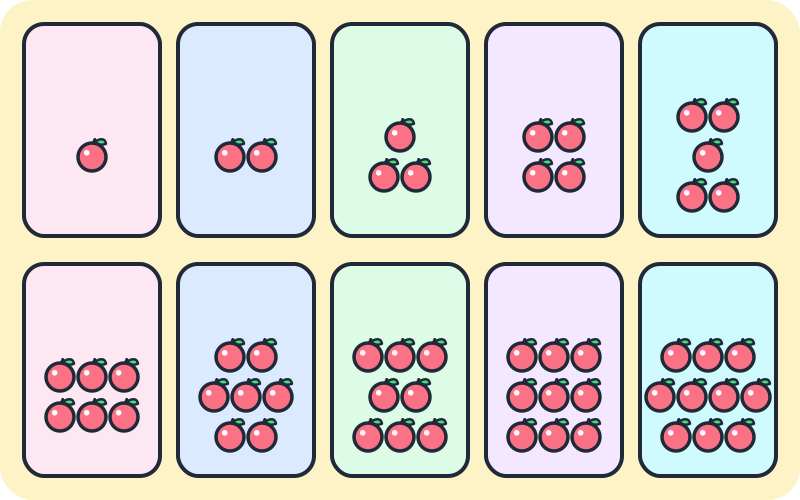
Count the apples from unus to decem. Only the first three change to agree with what they count.
The first three agree with what they count in case and gender. From four on, the number is indeclinable, and the noun carries the case on its own:
is feminine)
The teens, and why eighteen counts backwards
Eleven to seventeen are a unit fused onto ten, with some wear at the join:
| Value | Word | Value | Word |
|---|---|---|---|
| 11 | | 15 | |
| 12 | | 16 | |
| 13 | | 17 | |
| 14 | |
Then Latin changes direction. Eighteen is two-from-twenty and nineteen is one-from-twenty, and the in the middle is the preposition from:
The pattern runs at the top of every ten:
| Value | Word | Literally |
|---|---|---|
| 18 | | two from twenty |
| 19 | | one from twenty |
| 28 | duodetriginta | two from thirty |
| 29 | undetriginta | one from thirty |
| 39 | undequadraginta | one from forty |
| 99 | undecentum | one from a hundred |
, ten and eight, does turn up for eighteen (the Vulgate uses it), but the subtractive forms are the classical norm.
The tens and a hundred
| Value | Word | Value | Word |
|---|---|---|---|
| 20 | | 70 | |
| 30 | | 80 | |
| 40 | | 90 | |
| 50 | | 100 | |
| 60 | |
All indeclinable. Watch the vowel before -ginta: has a u, an o, and starts like nonus (ninth) rather than . English kept one of them: the Greek Old Testament is the Septuagint, after the seventy translators of the legend (the story actually has seventy-two, rounded down).
Going further: Unus: one, only, and a genitive of its own and the rest of the guide, when you want them. This lesson does not need them.
Practice
Practise this lesson
10-question session
One question at a time, mixed across the exercises in this lesson. Miss one and it comes back round before the end.
New words in this lesson




Latin · Free printables
Worksheets for this lesson
Worksheets with answer keys built in. Open any one to view, print or save.
Lesson 37 of 42 in this chapter