
Ch 1 · Lesson 18Latin · Chapter 1 · Lesson 18 · Grammar primer
Verb endings: why amo is a whole sentence
A Latin verb carries its own subject, which is why the pronoun is usually absent. Six endings run through most of the tenses in the language.
The short version
Six endings name the subject, so drop the pronoun
, ,
Why?Hide
A Latin verb ends with a syllable saying who is acting: -o for I, -s for you, -t for he or she, -mus for we, -tis for you plural, -nt for they. That is why is a complete sentence meaning I love. Those six run through most of the active tenses with only small adjustments, which makes this the highest-return table in Latin.
A pronoun that IS there is doing emphasis
, taces.
Why?Hide
, and all exist, and a Roman used them for contrast rather than for basic information. , taces means I am the one speaking and you are the one keeping quiet. Dropping pronouns in by default is the clearest tell of a beginner's Latin: if you would not stress the word in English, leave it out. Spanish and Italian inherited exactly this behaviour.
is a complete Latin sentence. One word, two syllables, subject and verb both present: I love. The - on the end is the I. In the present tense every Latin verb ends in one of six such endings, and each one names who is acting.
| Ending | Person | Latin | English |
|---|---|---|---|
- | I | | I say |
-s | you (one) | | you say |
-t | he, she, it | | he, she says |
-mus | we | | we say |
-tis | you (pl) | | you (pl) say |
-nt | they | | they say |
These six run through most of the active tenses with only small adjustments: the first person is sometimes -m instead of - (, I am), and the perfect has a set of its own. One table, years of use.
Why there are no pronouns
Because the ending has already done that job:
.- I say..- We say..- They say.
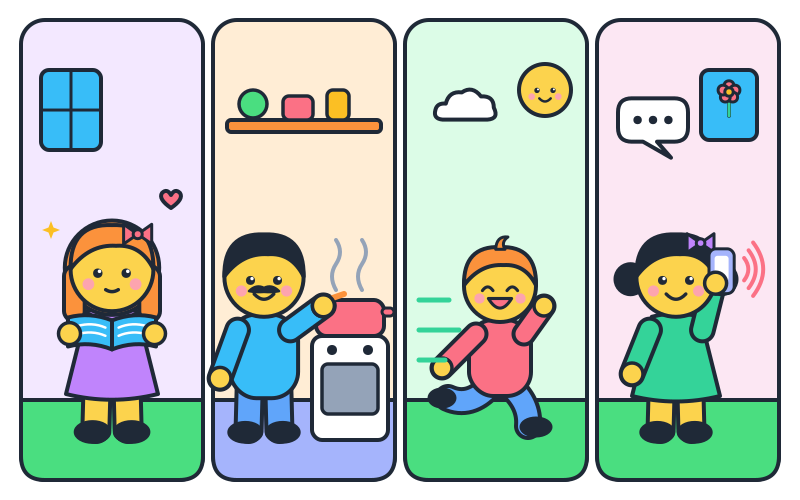
- .
- Coquit.
- Currit.
Legit, she reads; coquit, he cooks; currit, he runs. The -t says he or she, so Latin needs no pronoun: the picture shows who.
(I), (you) and (we) all exist. A Roman used them for contrast, not for basic information:
, taces.- I am the one speaking; you are keeping quiet.
Put the pronoun in by default and you have written the clearest sign of a beginner's Latin. If you would not stress the word in English, leave it out in Latin.
Spanish and Italian inherited this habit directly: Spanish hablo and Italian parlo are each a complete sentence, I speak. French wore its endings down until parle, parles and parlent sound alike, and its pronoun became compulsory.
Why dictionaries cite dico, not dicere
Every Latin dictionary lists a verb by its first person singular, I say, with the infinitive beside it:
| Headword | Infinitive | English |
|---|---|---|
| | I love, to love |
| | I have, to have |
| | I say, to say |
| | I hear, to hear |
This course follows the convention, so the vocabulary you learn here matches every other Latin resource. Learn the infinitive with the headword, though: and end the same way, and only and show that they belong to different families.
Going further: The four conjugations and the rest of the guide, when you want them. This lesson does not need them.
Practice
Practise this lesson
10-question session
One question at a time, mixed across the exercises in this lesson. Miss one and it comes back round before the end.
Latin · Free printables
Worksheets for this lesson
Worksheets with answer keys built in. Open any one to view, print or save.
Lesson 18 of 42 in this chapter