
Ch 1 · Lesson 3Spanish · Chapter 1 · Lesson 3 · Grammar primer
Say something today: hello and goodbye
Hola, buenos días, buenas noches, hasta luego: fixed phrases you can say to a real Spanish speaker today, before any grammar.
The short version
Buenos días, but buenas tardes and buenas noches
Buenas noches, señor.
Why?Hide
The time-of-day greetings change their ending to match the noun. Día is masculine, so buenos días; tarde and noche are feminine, so buenas tardes and buenas noches. In Spain buenos días lasts until lunch, around two, and buenas noches works both as hello after dark and as goodnight.
You can hold your first Spanish conversation before you have conjugated a single verb. Greetings and courtesies are fixed phrases: learn them whole, the way you learned thank you as a child, and use them today.
Here is the whole kit on one screen.
| Spanish | English | When |
|---|---|---|
| hello, hi | any time, anyone |
| good morning | until lunch |
| good afternoon | afternoon, evening |
| good evening, good night | night-time |
| goodbye | leaving |
| see you later | leaving, even a shop |
¿ ? | how are you? | after hello |
, | fine, thanks | the answer |
¿ ? | what's your name? | meeting someone |
Ana | my name is Ana | the answer |
| thank you | always |
| you' welcome | after |
| please | any request |
| sorry, excuse me | a small slip |
| I don't understand | when you are lost |
Greetings
is the one to learn first, because it never puts a foot wrong: morning or night, one person or a crowd, a friend or a stranger.
, Pedro.- Hi, Pedro..- Hello, everyone.
The other three greetings depend on the time of day. Spain eats late, so its afternoon runs late too: lasts until lunch (around two), and starts around nine. In much of Latin America the day turns at noon and the night at dusk.
Holaany time
Buenos días
Buenas tardes
Buenas nocheshello and goodnight
Timeline from 6:00 to midnight, with lunch marked.
Notice the endings. Día is a masculine word and tarde and noche are feminine, so the word for good changes to match: with días, with the other two. You will meet the reason in the noun gender lesson; for now the colour shows it.
| Greeting | English | Why the ending |
|---|---|---|
| good morning | is masculine |
| good afternoon | is feminine |
| good evening | is feminine |
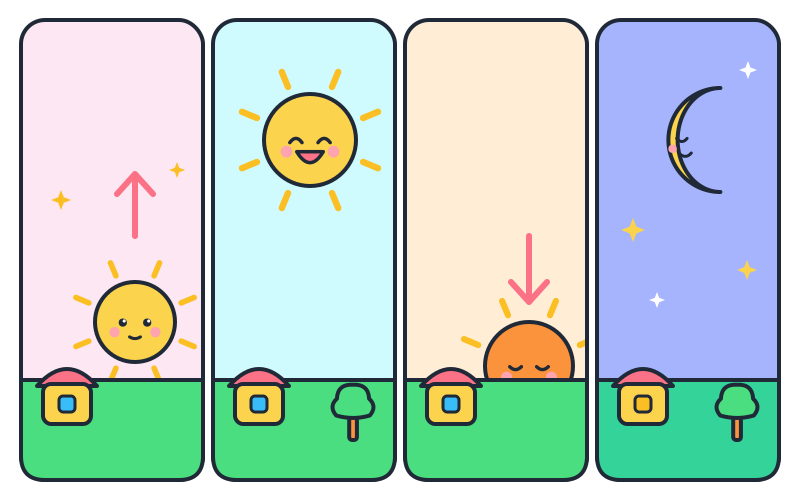
Midday has no label on purpose: Spain still says buenos días until lunch, while much of Latin America switches to buenas tardes at noon.
works both ways: hello when you arrive after dark, and goodnight when you leave or go to bed.
, .- Good evening, sir., Ana. .- Goodnight, Ana. See you later.
For goodbye, is the one everybody knows, but (literally until later) is what most people say, even to a shopkeeper they will never see again.
, .- Thanks, see you later., Pedro.- Goodbye, Pedro.
Going further: Getting by and the rest of the guide, when you want them. This lesson does not need them.
Practice
Practise this lesson
10-question session
One question at a time, mixed across the exercises in this lesson. Miss one and it comes back round before the end.
New words in this lesson

Spanish · Free printables
Worksheets for this lesson
Worksheets with answer keys built in. Open any one to view, print or save.
Lesson 3 of 17 in this chapter