
Ch 27 · Lesson 8Spanish · Chapter 27 · Lesson 8 · Grammar primer
The future and conditional of probability
¿ ? The future guesses about now ( ), the conditional about the past ( ).
The short version
Future guesses the present, conditional the past
¿ ?
Why?Hide
Where English scatters must, probably and I wonder, Spanish bends a whole tense to the job. ¿ ? asks what time it is now, not later. means he is probably at home. Shift the guess back in time and you shift to the conditional: , it was probably about three.
The four guesses on one screen
| Certain | The guess | English |
|---|---|---|
| he/she is probably | |
| he/she was probably | |
| ha | | he/she must have arrived |
| he/she had probably arrived |
The blue box is a future form, a guess about now. The dashed pink box is a conditional form, a guess about the past. The forms are the ones you know from the future and the conditional; here they stop telling time and start guessing.
- Está en casa.he/she is at home
- Estará en casa.he/she is probably at home
- Quizás esté en casa.perhaps he/she is at home
The weakest step, ., takes the subjunctive: see the subjunctive of doubt.
The future: a guess about now
Put a verb about the present into the future and the tense means "probably", "must" or "I wonder":
| Use | Spanish | English |
|---|---|---|
| the time | ¿ ? | I wonder what time it is. |
| where | . | He/She is probably at work. |
| age | . | He/She must be about thirty. |
| the doorbell | ¿ ? | Who can that be at this hour? |
| right now | . | They' probably having dinner. |
- .
- .
- .
- .
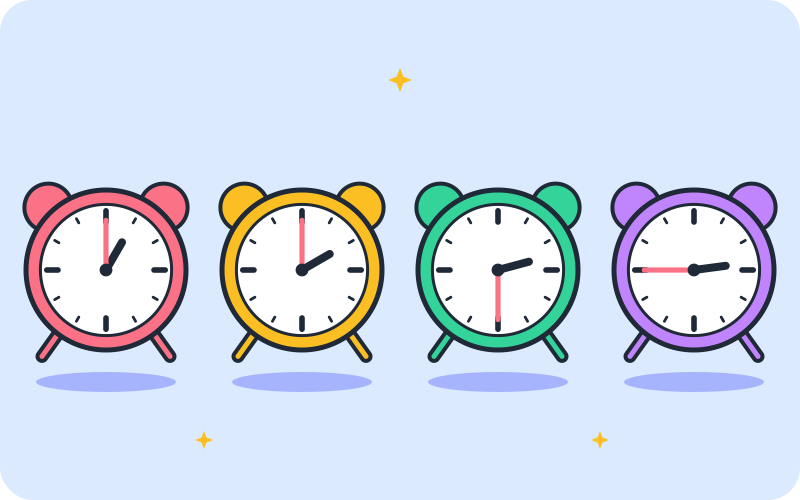
No numbers on the clocks, so every time is a guess: será la una (it must be one o'clock), serán las dos (it must be two), serán las dos y media (it must be half past two), serán las tres menos cuarto (it must be quarter to three).
The conditional: a guess about the past
Move the guess back in time and the future becomes the conditional:
serían las tres: it was probably about three (then)
serán las tres: it is probably about three (now)
Timeline from past to future, with now marked.
| Use | Spanish | English |
|---|---|---|
| the time | . | It was probably three when he/she arrived. |
| a state | . | She was probably tired. |
| age | . | He/She must have been about thirty then. |
| a crowd | . | There were probably about a hundred people. |
| no answer | ; . | He/She didn't answer; probably asleep. |
Set the two side by side:
.- It's probably about three (now)..- It was probably about three (then).
The conditional of probability loves a rough number with or : (about a hundred people).
Guess or real future?
The same form can be a guess or a real future. Ask what time the sentence is about:
| Read as | Spanish | English |
|---|---|---|
| a guess | . | He/She is probably at home now. |
| a real future | . | He/She will be at home tomorrow. |
| a guess | . | She was probably tired yesterday. |
| a real "would" | , . | With so much work, anyone would be tired. |
With no time word, a future about something you cannot see right now is usually a guess: . . (He/She isn't answering. He/She is probably asleep.)
Going further: Finished actions: habrá llegado, habría salido and the rest of the guide, when you want them. This lesson does not need them.
Practice
Practise this lesson
10-question session
One question at a time, mixed across the exercises in this lesson. Miss one and it comes back round before the end.
Spanish · Free printables
Worksheets for this lesson
Worksheets with answer keys built in. Open any one to view, print or save.
Free for members
The printable worksheets, infographics and PDFs are free with an account. Start a free week and download as many as you like.
Start your free weekLesson 8 of 28 in this chapter