
Ch 30 · Lesson 17Esperanto · Chapter 30 · Lesson 17 · Grammar primer
At the table: mendi, bonan apetiton, je via sano
Order with and ; keeps the -n of a verb left out; has none; and hunger and thirst are verbs: .
The short version
ends in -n for a reason
!
Why?Hide
is the object of a verb that has been left out: , I wish you a good appetite. The verb goes, the -n stays, as in and . The toast has no -n, because comes after a preposition.
Hunger and thirst are verbs
.
Why?Hide
Esperanto says , I am hungry, and , I am thirsty, with the verbs and . also works, but the verb is shorter. is just mal- plus , full, so when you have eaten enough you are .
At an Esperanto table you need one verb, (to order), and a few fixed phrases. Two of the phrases end in -n because a verb has been left out.
| English | Esperanto |
|---|---|
| ll have soup. | . |
| Enjoy your meal! | ! |
| Cheers! | ! |
| The bill, please | , . |
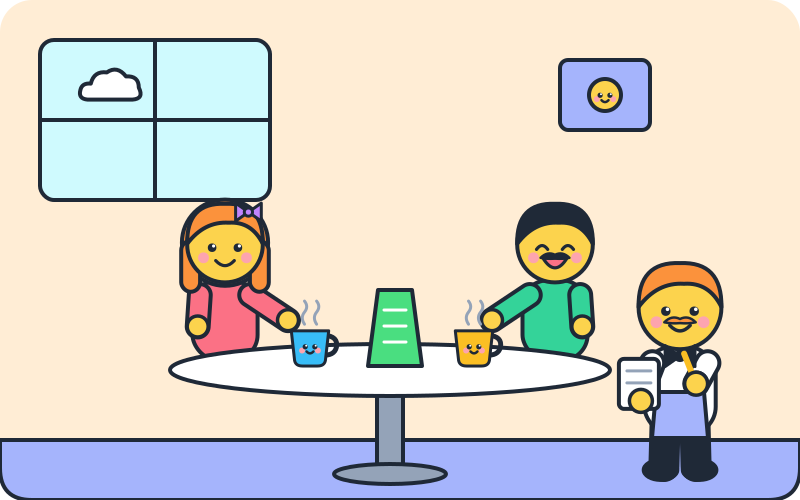
La klientino the customer (a woman), la kliento the customer (a man), la kelnero the waiter, la menuo the menu, la tasoj the cups.
Ordering: mendi
covers ordering food, ordering goods and booking a room. After a quantity word, such as a glass or a bottle, the food comes after , not :
.- I will have soup and a glass of wine..- I would like to order the fish..- We ordered a bottle of water.
, I would like, is the polite conditional. Quantity has the full rule for .
| Word | English |
|---|---|
| restaurant |
| waiter |
| menu |
| a course |
| the bill |
| to pay |
Bonan apetiton and je via sano
! is said before a meal. The full sentence is , I wish you a good appetite. The verb has gone and the -n of its object has stayed. Other greetings and wishes have the same shape:
!- Enjoy your meal!!- Good day!!- Thank you!
! is the toast, or just !. After there is no -n: the preposition already shows the role.
: !- We raised our glasses: To your health!
is the preposition Esperanto uses when no other one fits, and PMEG advises avoiding it when a better one exists. In this fixed phrase it is the usual word. Tricky prepositions has more on .
Hungry, full and thirsty
Hunger and thirst are verbs in Esperanto:
| Say it | English |
|---|---|
. | I am hungry. |
. | I am thirsty. |
. | I have had enough. |
is. | I had a snack. |
, hungry, is - plus , full: there is no third root to learn. is also correct, but the verb is shorter.
How much you eat runs from a snack to your fill:
- manĝeti
- manĝi
- satiĝi
i- to eat a little, a snack between meals- to eati- to eat until you are no longer hungry
Going further: Trinki or drinki and the rest of the guide, when you want them. This lesson does not need them.
Practice
Practise this lesson
9-question session
One question at a time, mixed across the exercises in this lesson. Miss one and it comes back round before the end.
Esperanto · Free printables
Worksheets for this lesson
Worksheets with answer keys built in. Open any one to view, print or save.
Free for members
The printable worksheets, infographics and PDFs are free with an account. Start a free week and download as many as you like.
Start your free weekLesson 17 of 26 in this chapter