
Ch 1 · Lesson 25Esperanto · Chapter 1 · Lesson 25 · Grammar primer
Mia and sia: whose is it?
Add -a for the owner: , , . It agrees with the thing owned, , and says his own where would mean someone else's.
The short version
One table, two endings:
, .
Why?Hide
Every Esperanto pronoun works the same way. Add -n for the object and -a for the possessive: , , ; , , ; , , . The possessive is an ordinary adjective, so it agrees with its noun: , .
.
Why?Hide
English he sees his book does not tell you whose book it is. Esperanto does: in the third person, points back at the subject, and , or point at somebody else. You never need it with or , which are never ambiguous.
Possessives: add -a
-a is the adjective ending, so is literally me-ish: belonging to me. That has one consequence. A possessive agrees with its noun like any adjective, taking -j for several and -n for the object:
| Subject | Object | |
|---|---|---|
| one | | |
| several | | |
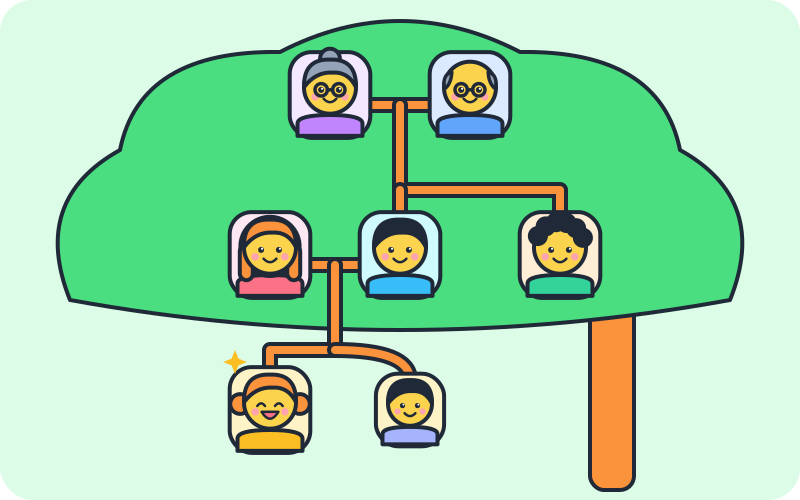
The girl at the bottom is speaking: everyone else in the tree is mia, my.
.- My book is there.?- Do you see my books?
The possessive agrees with the thing owned, not the owner. has -j because there are several books; there is still only one of me. No is needed either:
.- Our day was good.
Si and sia: his own, her own
English he sees his book cannot tell you whose book it is. Esperanto can. In the third person, points back at the subject; , and point at someone else.
| Esperanto | English |
|---|---|
. | He sees his own house. |
. | He sees another s house. |
. | She sees her own house. |
agrees like any possessive, and has the object form :
.- They see their own books..- He washes himself.
Two limits. It is third person only, because and are never ambiguous:
.- I see my book.
And it never goes inside the subject:
.- His book is good. (never
The full treatment is in the reflexive.
Going further: The whole system on one screen and the rest of the guide, when you want them. This lesson does not need them.
Practice
Practise this lesson
10-question session
One question at a time, mixed across the exercises in this lesson. Miss one and it comes back round before the end.
Esperanto · Free printables
Worksheets for this lesson
Worksheets with answer keys built in. Open any one to view, print or save.
Lesson 25 of 51 in this chapter