
Ch 1 · Lesson 42Esperanto · Chapter 1 · Lesson 42 · Grammar primer
How Esperanto numbers work
Tens and hundreds join up (), everything else stays apart ( , ): the whole number system in one spelling rule, plus the -a that turns any number into first, second, third.
The short version
Tens and hundreds join up; everything else stays apart
,
Why?Hide
Nine roots plus , cent and give you every number in Esperanto, and one spelling rule assembles them. Tens and hundreds are written solid: is two tens, is two hundreds. Everything else stays apart: is ten plus two, and (never ) is two thousand. So is 22 and is 123. There is no thirteen--three irregularity waiting for you, because nothing here is irregular.
Cardinals do not take -j or -n
.
Why?Hide
In the noun picks up both endings and stays untouched. Speakers of Slavic and Romance languages expect the number to react, and it does not (only , used as a pronoun, can: unuj , some and the others). The only numbers that decline are the ones that have stopped being numbers: ordinals are adjectives, , and forms like and are nouns. Endings and suffixes build those out of a cardinal: -a, -o, -on-, -obl- and -op-.
Learn nine roots plus , and , and one spelling rule joins them into every number in Esperanto. Tens and hundreds join (, twenty); everything else stays apart ( , twelve). Nothing is irregular.
Ninety-seven is , nine-ten seven, where French needs quatre-vingt-dix-sept and English hides the ten inside eleven and twelve.
The whole vocabulary
| Number | Word | Number | Word |
|---|---|---|---|
| 0 | | 6 | |
| 1 | | 7 | |
| 2 | | 8 | |
| 3 | | 9 | |
| 4 | | 10 | |
| 5 | | 100 | |
| 1000 | |
 one
 two
 three
 four
 five
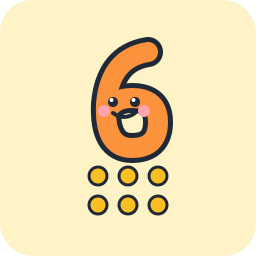 six
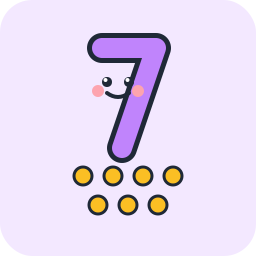 seven
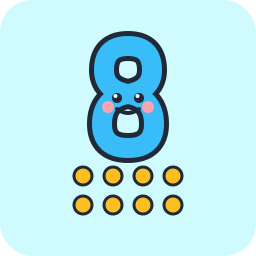 eight
 nine
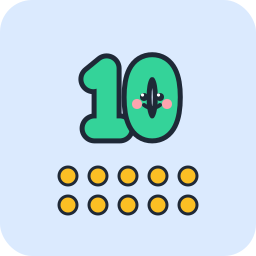 ten
That is the list. Every number up to 999,999 is built from these:
.- I have two books.aĝa.- She is ten years old.
Zero
is the numeral; is the noun, for zero as a thing:
.- The temperature is below zero.
Saying them
Esperanto spelling is phonetic, so the only traps are letters English reads differently:
| Word | Say it | The trap |
|---|---|---|
| tsent | c is always ts, never the coin |
| | a real k then a real v, not kw |
| now | one syllable: ŭ is a w glide |
| | stress falls on the second-to-last |
The join rule
Two operations, two spellings:
| Number | Esperanto | Working |
|---|---|---|
| 12 | | 10 + 2 |
| 20 | | 2 x 10 |
| 22 | | 2 x 10 + 2 |
| 90 | | 9 x 10 |
| 101 | | 100 + 1 |
| 123 | | 100 + 20 + 3 |
| 200 | | 2 x 100 |
| 250 | | 200 + 50 |
| 999 | | 900 + 90 + 9 |
is a joined ten and a separate unit in one breath; after that, the number line writes itself. In a sentence:
.- She is twenty-two. (literally: has twenty-two years)
The join happens only with and . always stays a separate word, because almost anything can stand in front of it ( , 333,000):
as a misspelling)
The popular shortcut, "multiplication joins, addition stays apart", is right everywhere except here.
The number line from 11 to 1,000
Every ten and hundred, written out. Each one is the join rule applied once.
The teens and the tens
| Number | Esperanto | Number | Esperanto |
|---|---|---|---|
| 11 | | 20 | |
| 12 | | 30 | |
| 13 | | 40 | |
| 14 | | 50 | |
| 15 | | 60 | |
| 16 | | 70 | |
| 17 | | 80 | |
| 18 | | 90 | |
| 19 | | 100 | |
The hundreds
| Number | Esperanto | Number | Esperanto |
|---|---|---|---|
| 100 | | 600 | |
| 200 | | 700 | |
| 300 | | 800 | |
| 400 | | 900 | |
| 500 | | 1000 | |
They do not decline
Cardinals take no -j and no -n. The noun takes both; the number sits still:
.- I see three books.
If your first language puts endings on numbers, this is the habit to drop, and nothing replaces it. The one exception is as a pronoun rather than a count:
unuj- the ones and the others
Words built from numbers do decline, because they are no longer numbers. An ordinal is an adjective; is a noun:
Going further: Thousands, millions and billions and the rest of the guide, when you want them. This lesson does not need them.
Practice
Practise this lesson
10-question session
One question at a time, mixed across the exercises in this lesson. Miss one and it comes back round before the end.
New words in this lesson





Esperanto · Free printables
Worksheets for this lesson
Worksheets with answer keys built in. Open any one to view, print or save.
Lesson 42 of 51 in this chapter