
Ch 1 · Lesson 22Esperanto · Chapter 1 · Lesson 22 · Grammar primer
Verb tenses: -as, -is, -os
Present, past, future: one ending each, no irregular verbs, and the same form for every person. -u and -us come next.
The short version
Five endings, and not one irregular verb
, ,
Why?Hide
Drop the -i from the infinitive and add -as for the present, -is for the past, -os for the future, -us for the conditional or -u for a command. That is the entire verb system. There are no irregular verbs in Esperanto, and the verb to be proves it: gives , , , , , every one of them the form you would have guessed.
The ending never changes for person
, ,
Why?Hide
One form covers everybody: , , , , . The pronoun already says who is acting, so the verb does not repeat it. English needs am, is and are for that same column and French needs six forms, irregularly. This single rule removes the largest memorisation load in most European languages.
Drop the -i from the infinitive and add one of five endings. The ending never changes for the person, and no verb is irregular. That is the entire Esperanto verb system.
The whole system on one screen
| Ending | Use | | English |
|---|---|---|---|
-i | infinitive | | to be |
-as | present | | am, is, are |
-is | past | | was, were |
-os | future | | will be |
-us | conditional | | would be |
-u | command | | be! |
The root est- never changes. Watch one verb go through every tense:
Each tense in a sentence:
.- I see him now..- I saw him..- I will see him., .- I would see him, if I could.!- Look! (literally: see!)

- .
- .
- .
Yesterday, today, tomorrow: the root stays put and only the ending moves, -is, -as, -os.
One form for every person
The ending is the same whoever does the action:
| Pronoun | Esperanto | English |
|---|---|---|
| I am | |
| you are | |
| / / | | he / she / it is |
| we are | |
| they are |
English needs am, is and are for this column; French needs six forms, irregularly. In Esperanto the pronoun already says who, so the verb does not repeat it.
Because the verb does not say who, the subject pronoun stays in the sentence: . is I am there, and on its own does not say who is. Two kinds of sentence have no subject to say:
.- It is raining. (weather has no it)!- Come! (theis understood)
No irregular verbs, not even to be
To be is irregular in almost every language. English be has eight shapes: be, am, is, are, was, were, being, been. Esperanto's has six forms, and each is the root plus the ending you would have predicted. Every other verb works the same way:
| Verb | Present | Past | Future |
|---|---|---|---|
| | | |
| | | |
| | | |
| | | |
| | | |
| Verb | Would | Command | English |
|---|---|---|---|
| | | to have |
| | | to see |
| | | to speak |
| | | to go |
| | | to know |
You could have generated every cell yourself. That is the point. ( looks odd with its double i, but the root is sci-: , she knows.)
One present, one past: no continuous to learn
-as covers both English presents, and -is both pasts:
.- I speak. / I am speaking..- She read. / She was reading.
- .
- .
- .
- .
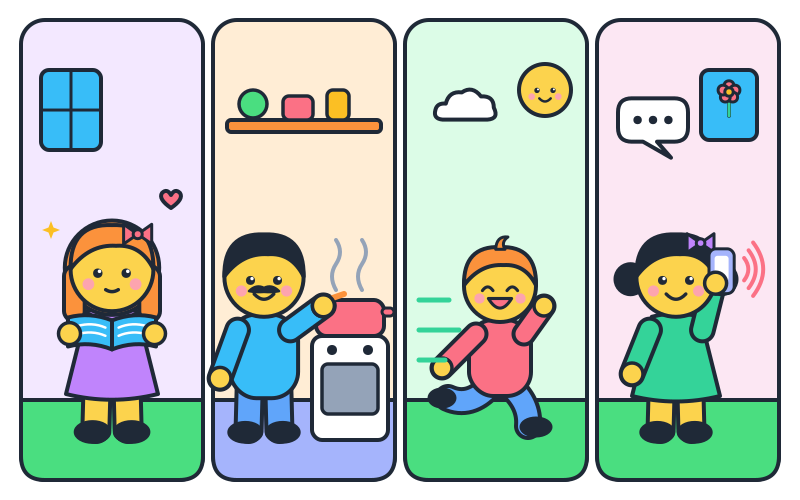
Each of them is doing it right now, and plain -as says so: she is reading, he is cooking, he is running, she is on the phone.
There is no am speaking form to build. is not Esperanto, and the participle forms ( ) are rare and heavy: plain -as and -is are the natural choice.
Going further: When to use -u and the rest of the guide, when you want them. This lesson does not need them.
Practice
Practise this lesson
10-question session
One question at a time, mixed across the exercises in this lesson. Miss one and it comes back round before the end.
Esperanto · Free printables
Worksheets for this lesson
Worksheets with answer keys built in. Open any one to view, print or save.
Lesson 22 of 51 in this chapter