
Ch 2 · Lesson 34Esperanto · Chapter 2 · Lesson 34 · Grammar primer
Word building: mal- and -in-
You have just met and . Here is the machinery behind them: mal- flips a word to its opposite, -in- makes it female, ge- takes both.
The short version
mal- flips a word to its exact opposite
,
Why?Hide
The most useful morpheme in the language. is good and is bad, is big and is small, is to love and is to hate. Every antonym pair in English costs a learner two unrelated words; in Esperanto it costs one root and a prefix you learn once. That alone is several hundred words you were never taught.
-in- makes it female and ge- takes both
, ,
Why?Hide
is father and is mother, and you already knew both without knowing they were built. The same suffix gives from , from and from . Then ge- on the front takes both sexes together, so is parents, which English cannot do without reaching for an entirely different word.
An affix bolts onto a root and changes its meaning in a fixed way, on any root where the meaning makes sense. You have already met and : they are and with a piece added. Learn seven pieces and every root you know multiplies.
| Affix | Job | Example |
|---|---|---|
- | exact opposite | |
-- | female | |
- | both sexes together | |
- | again, back | |
-- | the place for it | |
-- | the professional | |
--, -- | smaller, bigger | |
Prefixes go before the root; suffixes go between the root and the ending, which keeps its usual job:
mal- reverses everything
Put - on the front and the meaning flips to its exact opposite:
| Root you know | With - | Meaning |
|---|---|---|
| , good | | bad |
| , big | | small |
| , new | | old |
| , strong | | weak |
| , fast | | slow |
| , long | | short |
| , to love | | to hate |
| , to help | | to hinder |
 big
 small
 warm
 cold
.- The house is small..- They hate winter.
Good and bad, big and small share nothing in English: two words to learn each time. In Esperanto every pair costs one root plus a prefix you learn once.
-in- makes it female
-- sits between the root and the -o:
| Root | With -- | Meaning |
|---|---|---|
| , man | | woman |
| , father | | mother |
| , sir | | madam |
| , king | | queen |
.- My mother is good.
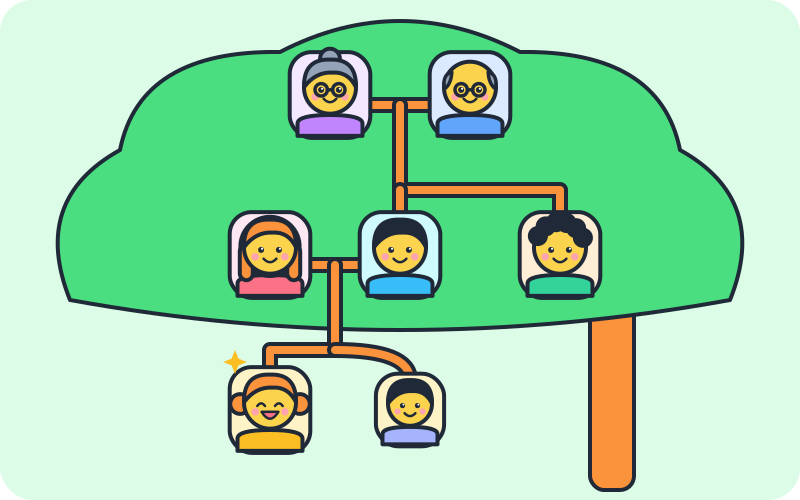
Every woman in the tree is the man’s word plus -in-: avino, patrino, fratino.
- on the front takes both sexes together, so the word is usually plural:
| Pair | With - | Meaning |
|---|---|---|
| + | | parents |
| + | | ladies and gentlemen |
Parizo.- My parents live in.
Going further: The place, the person, the repeat and the rest of the guide, when you want them. This lesson does not need them.
Practice
Practise this lesson
8-question session
One question at a time, mixed across the exercises in this lesson. Miss one and it comes back round before the end.
Esperanto · Free printables
Worksheets for this lesson
Worksheets with answer keys built in. Open any one to view, print or save.
Lesson 34 of 43 in this chapter