
Ch 2 · Lesson 14Esperanto · Chapter 2 · Lesson 14 · Grammar primer
Kia, kiom, kies, kien: the question words that behave differently
agrees like an adjective, takes , never changes, asks where to, and a preposition goes first: , .
The short version
?
Why?Hide
Three ki- words behave differently. is an adjective and agrees with its noun: . asks how much or how many, and a noun after it takes : . never changes; any -n goes on the noun after it: . And a preposition always goes first: , never ... .
Kia, kiom and kies: three that behave differently
is an adjective, so it agrees with its noun:
?- What kind of books do you read?
asks about quality; asks which individual:
| Word | Esperanto | Wants as an answer |
|---|---|---|
| ? | a big old one |
| ? | that one on the corner |
asks how much or how many. A noun after it takes :
?- How much coffee do you drink??- How many children came?
never changes. When the thing owned is the object, the noun takes the -n:
?- Whose book did you take?
Kie and kien: where, and where to
The -n ending also marks direction. asks where something is; asks where it is going:
| Word | Esperanto | English |
|---|---|---|
| ? | Where do you live? |
| ? | Where are you going (to)? |
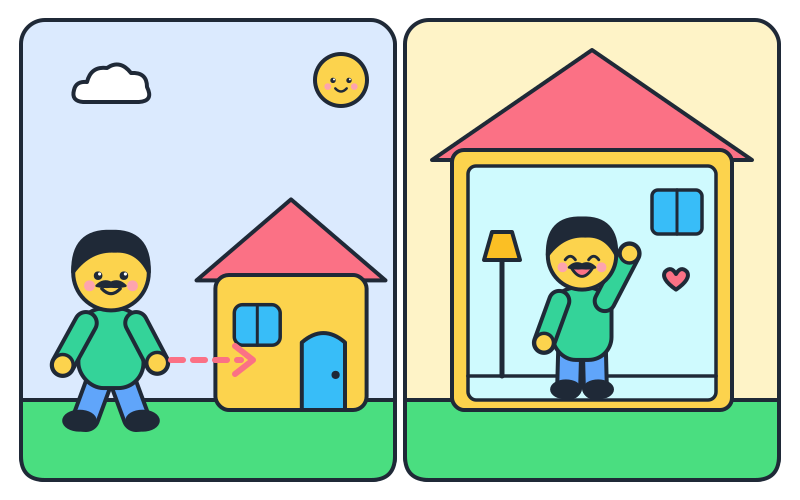
- ? .
- ? .
On his way in, he is going kien, into the house, with -n; once inside he is kie, in the house, with none.
English lost this split with whither. ? for where are you going? marks an English speaker at once.
With a preposition
A preposition goes in front of the question word, never stranded at the end:
| Esperanto | English |
|---|---|
? | Who are you talking to? |
? | What are you talking about? |
? | Who did you come with? |
After a preposition the ki- word normally takes no -n ( , not ): the preposition already shows its role. The one exception is direction after a place preposition such as or :
?- Which room do you sleep in??- Which room are you going into?
The prepositions page has the list.
The same words without a question
The ki- words also open relative clauses and indirect questions, with the same endings and the same -n:
| Use | Esperanto | English |
|---|---|---|
| relative: who | , , . | The man who came is my brother. |
| relative: which | , , . | The book I am reading is long. |
| indirect question | , . | I do not know where he lives. |
How these clauses attach, and where the commas go, is in subordinate clauses.
Going further: Kiu against kio and the rest of the guide, when you want them. This lesson does not need them.
Practice
Practise this lesson
9-question session
One question at a time, mixed across the exercises in this lesson. Miss one and it comes back round before the end.
Esperanto · Free printables
Worksheets for this lesson
Worksheets with answer keys built in. Open any one to view, print or save.
Lesson 14 of 43 in this chapter