
Ch 2 · Lesson 35Esperanto · Chapter 2 · Lesson 35 · Grammar primer
Word building: -ej-, -ist-, re- and the volume knob
, , , : the place, the person, the repeat and the size pair, and why 200 roots is far more than 200 words.
The short version
-ej- is the place, -ist- the person, re- again
.
Why?Hide
Three affixes carry a lot of traffic. -ej- makes the place for the root: , a school. -ist- makes the person who does it as a job: , a teacher. re- on the front means again or back: , to come back. Each works on any root where the meaning makes sense.
-et- and -eg- are the
, , o
Why?Hide
A matched pair that scales a root down or up. is a house, a cottage, o a mansion. is to look, rigardeti to glance, rigardegi to stare. English reaches for a different word each time and you have to store all three; Esperanto turns a dial. The other two worth knowing early are -ej-, the place for something, and -ist-, the person who does it.
The place, the person, the repeat
Three more that carry a lot of traffic:
| Affix | Root | Built | Meaning |
|---|---|---|---|
-- | , to learn | | school |
-- | , to work | | workplace |
-- | , to cook | | kitchen |
-- | , to teach | | teacher |
-- | , to work | | worker |
-- | | speaker | |
- | , to come | | to come back |
- | , to give | | to give back |
- | , to see | | to see again |
In sentences:
.- The children go to school..- She is a teacher..- I will come back tomorrow.
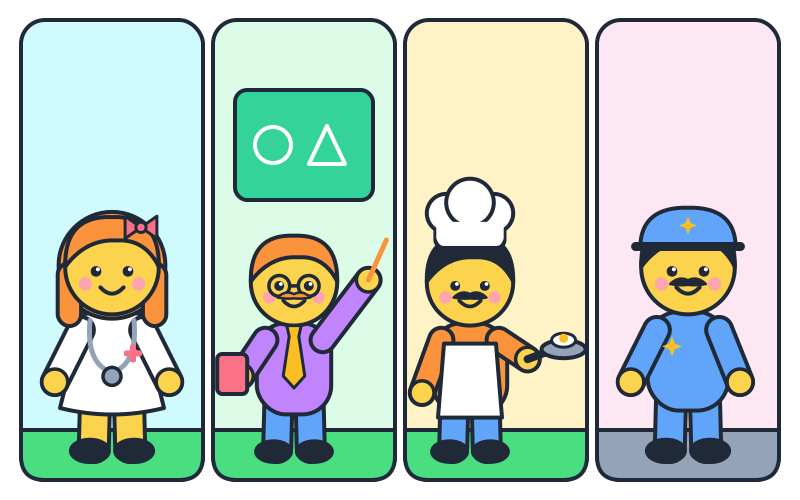
Three jobs, one suffix: the root says what the work is, -ist- makes the person who does it. The doctor is a woman, so -in- follows: kuracistino.
-- is the person who does something as a job, or an adherent of something. A learner is , not a professional learner.
Some built words mean one particular thing and are worth learning whole: o is a kitchen, not any place where cooking happens.
-et- and -eg-: the volume knob
A matched pair that turns the root down or up, whatever its part of speech:
| Smaller | Root | Bigger |
|---|---|---|
| , house | |
grandeta biggish | , big | |
 a cottage
 a house
 big
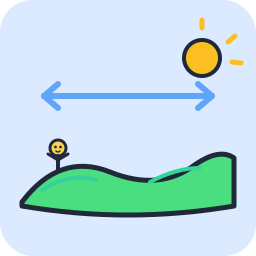 enormous
.- They live in a cottage.
The size pair, and --, -- and -- for people, have their own article: Esperanto suffixes for size and people.
This is why 200 roots is not 200 words
Take one root, bon-, and apply the endings and affixes:
| Word | Built from | Meaning |
|---|---|---|
| root + -a | good |
| root + -e | well |
| root + -o | a good thing |
| - | bad |
| - + -e | badly |
| -- | excellent |
| -- | fairly good |
| -- | to improve |
| - + -- | a wicked person, a villain |
Nine words from one root, with pieces that work the same on every other root you hold. That is the defensible form of the claim that Esperanto is faster: the vocabulary compounds, because the word-building system is regular and nobody has to approve a new combination.
Some built words narrow to one meaning, and those you learn by name:
o- a hospital (literally a place for sick people)o- a prison (literally a place of unfreedom)
Going further: mal- reverses everything and the rest of the guide, when you want them. This lesson does not need them.
Practice
Practise this lesson
8-question session
One question at a time, mixed across the exercises in this lesson. Miss one and it comes back round before the end.
Esperanto · Free printables
Worksheets for this lesson
Worksheets with answer keys built in. Open any one to view, print or save.
Lesson 35 of 43 in this chapter