
Ch 2 · Lesson 16Esperanto · Chapter 2 · Lesson 16 · Grammar primer
Ĉi tiu, tiuj, tiun: this, and the endings
There is no word for this: pulls closer. And takes -j and -n like an adjective, , while takes -n only.
The short version
.
Why?Hide
Before a noun, behaves exactly like an adjective such as : it takes the plural -j and the accusative -n whenever its noun does. So it is for those people, and when that person is the object. takes -n but never -j.
ĉi: pulling that into this
There is no separate word for this. The particle drags a pointing word towards the speaker:
| Far | Near |
|---|---|
| this one |
| this |
| here |
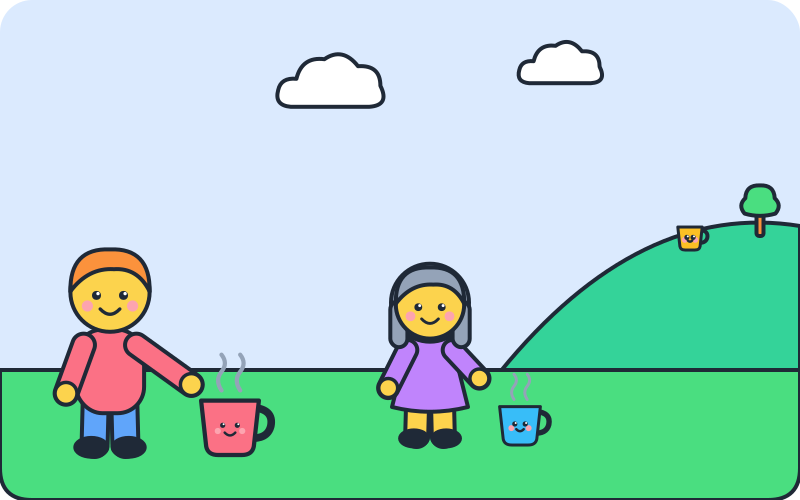
Two steps, not three: ĉi tiu for the cup by the speaker, plain tiu for the cup by the listener and the one on the hill alike.
can stand on either side. Both of these are correct:
.- This book is good..- This book is good.
on its own before a noun ( ) does turn up, but it is widely judged best avoided outside poetry. Give it its : .
Number and case: the part English does not prepare you for
takes the plural -j and the accusative -n, together when both apply. takes -n but never -j:
| Form | Esperanto | English |
|---|---|---|
| . | Those gentlemen speak. |
| . | I see that gentleman. |
| . | I see those gentlemen. |
| . | I did not say that. |
The endings free the word order. Front the object for emphasis and the -n still says who sees whom:
.- I see that person..- THAT person is the one I see.
The rest of the ti- family
and are two cells of a column. The other common ones point at a place, a time, a manner or a kind:
| Word | Esperanto | English |
|---|---|---|
| . | He is there. |
| . | Then I came. |
| ! | Do not talk like that! |
| . | I have never seen such a person. |
All nine are in the correlative table.
Going further: Tiu: that one and the rest of the guide, when you want them. This lesson does not need them.
Practice
Practise this lesson
9-question session
One question at a time, mixed across the exercises in this lesson. Miss one and it comes back round before the end.
Esperanto · Free printables
Worksheets for this lesson
Worksheets with answer keys built in. Open any one to view, print or save.
Lesson 16 of 43 in this chapter