
Ch 1 · Lesson 2Portuguese · Chapter 1 · Lesson 2 · Grammar primer
Say hello today: oi, olá, bom dia
Oi for anyone, a touch more formal, and , or by the clock: the hellos you can use on day one, before any grammar.
The short version
, !
Why?Hide
The greeting agrees with its noun. is masculine, so it is ; and are feminine, so they take . The clock picks which one: until about midday, until dark, and after dark, both as hello and as goodbye.
You can hold your first conversation in Brazilian Portuguese today, before you learn a single verb ending. Greetings are fixed phrases: learn them whole and use them at once. There are two small traps, and both are flagged below.
The whole system on one screen
Learn the left column; the rest of the page shows when to use each one.
| Say this | It means | Use it |
|---|---|---|
| hi, hello | anyone, any time |
| hello | a touch more formal |
| good morning | until about midday |
| good afternoon | midday until dark |
| good evening, good night | after dark |
? | how are you? | almost every hello |
| bye | almost every goodbye |
| see you later | when you will meet again |
| see you tomorrow | colleagues, neighbours |
| thank you | man / woman speaking |
| please | asking for something |
| excuse me | to get past or interrupt |
| sorry | after a mistake |
| you're welcome | reply to thanks |
... | my name is... | introducing yourself |
This page teaches Brazilian Portuguese. Where says something different, it is labelled EP.
- E aí?what’s up? (friends)
- Oihi (anyone)
- Oláhello (emails, TV)
- Bom diagood morning (shops, work)
- Como vai o senhor?how are you, sir?
Oi and olá: hello
is the everyday Brazilian hello: friends, neighbours, shop staff, strangers, any hour. Brazilians often stack it with a time-of-day greeting.
, ?- Hi, how are you?, !- Hi, good morning!
is a touch more formal. In Brazil it lives in writing, emails and television more than across a shop counter.
| Situation | Natural choice | English |
|---|---|---|
| friend in street | ! | Hi! |
| start of email | , Ana. | Hello, Ana. |
| stranger in lift | , ! | Hi, good morning |
has one more job. Said as a question, it answers someone who calls your name, or asks them to repeat:
?- Yes? / Sorry, what?
EP: in is the everyday hello and sounds Brazilian: , ?
Bom dia, boa tarde, boa noite
These three are the polite hellos, chosen by the clock. In Brazil you say one when you walk into a shop, a lift or a waiting room: ! to the room is ordinary manners.
Waking up to noonBom dia
good morning
Noon to darkBoa tarde
good afternoon
Dark to bedtimeBoa noite
good evening, and good night
does double duty: hello when you arrive after dark, and goodbye when you leave or go to bed.
! , .- Good evening! A table, please., !- Good night, see you tomorrow!
In most of Brazil it is dark by about six, so starts early.
Why bom but boa?
The adjective agrees with the noun. is masculine, and are feminine.
| Greeting | Noun's gender | English |
|---|---|---|
| masculine | good morning |
| feminine | good afternoon |
| feminine | good night |
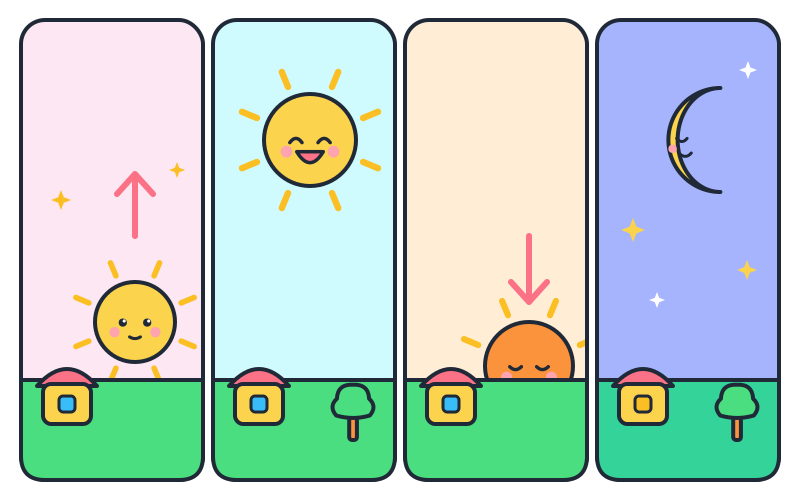
Bom dia until about midday, boa tarde until dark, boa noite after dark. Dia is masculine, so bom; tarde and noite are feminine, so boa.
Going further: Tudo bem? How are you, Brazilian style and the rest of the guide, when you want them. This lesson does not need them.
Practice
Practise this lesson
9-question session
One question at a time, mixed across the exercises in this lesson. Miss one and it comes back round before the end.
New words in this lesson
 oiojhi, hello
 oláoˈlahello
- bom diabõ ˈdʒiɐgood morning; hello (until about midday)
- boa tardeˈboɐ ˈtaʁdʒigood afternoon; hello (from midday until dark)
- boa noiteˈboɐ ˈnojtʃigood evening; good night (as a greeting after dark, and at bedtime)
- tudo bemˈtudu ˈbẽj̃how are you?; fine, all good; that's OK
- e aíi aˈiwhat's up?, how's it going?; so?, and then?
- com licençakõ liˈsẽsɐexcuse me (to get past, to come in, or to leave)
 bem-vindobẽjˈvĩduwelcome
 bombõgood; kind
 o dia(masculine)ˈdʒiɐday
 a tarde(feminine)ˈtaʁdʒiafternoon; late
 a noite(feminine)ˈnojtʃinight; evening
 tudoˈtudueverything
 bembẽj̃well; quite, very
 tchauˈtʃawbye, goodbye
 atéaˈtɛuntil, up to; as far as; even
 logoˈlɔɡusoon, right away
 amanhãamaˈɲɐ̃tomorrow
- obrigadoobɾiˈɡaduthank you (said by a man; a woman says obrigada)
 dedʒiof, from
 nadaˈnadɐnothing, anything
 porpoʁby, through; for, because of; per
 o favor(masculine)faˈvoʁfavour
 comkõwith
 a licença(feminine)liˈsẽsɐpermission; leave (from work); licence
 a desculpa(feminine)disˈkuwpɐapology, excuse; sorry (used as an interjection: desculpa!)
 euewI
 vocêvoˈseyou (singular); plural vocês
 eiand
 chamarʃaˈmaʁto call
 meumewmy; mine (masculine)
 o nome(masculine)ˈnominame
 serseʁto be (identity, origin, lasting qualities: what something is)
 muitoˈmũj̃tuvery, a lot, much
 o prazer(masculine)pɾaˈzeʁpleasure
 o senhor(masculine)seˈɲoʁsir, Mr; gentleman; you (formal, as o senhor)
 a senhora(feminine)seˈɲoɾɐlady, madam
Portuguese · Free printables
Worksheets for this lesson
Worksheets with answer keys built in. Open any one to view, print or save.
Lesson 2 of 40 in this chapter