
(qù) - to go in Mandarin
qùTraditional: 去

Translation
to go
Word origin
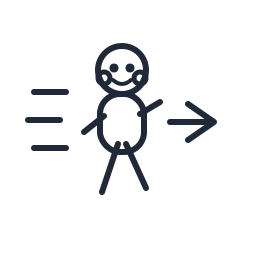
去 (qù) shows a person above an enclosure or opening, an image of leaving a place. It means 'to go' or 'to leave', and also serves as a directional complement marking movement away from the speaker.
- Origin
- ideograph
- Root
- 大 (person) over 厶 (an opening/enclosure)
Stroke order

去
Examples
?
Where are you going?
课。
I am going to school for class tomorrow.
。
He went to the supermarket to buy things.
。
I'm going to Shanghai tomorrow.
。
He went to France last year.
去 (qù) is one of the most fundamental movement verbs in Mandarin. Its character depicts a person departing - the top component suggests a person and the bottom suggests movement away. As a directional complement, 去 can follow other verbs to indicate movement away from the speaker, contrasting with 来 (lái), which indicates movement toward the speaker.
In everyday speech, 去 appears in countless fixed expressions and compound words. It pairs naturally with destinations (去学校, go to school; 去医院, go to hospital) and can serve as a complement after verbs of motion to specify direction. The verb is used in both formal and informal registers without variation.
Where this fits
Appears in 11 words
Multi-character compounds in the corpus that contain 去.
Used in
Stories
(18)你去吗?
1 min read · Core 1000
在这里
1 min read · Core 1000
不知道在哪里
2 min read · Core 1000
点错了
2 min read · Core 1000
错过公车
3 min read · Core 1000
打电话
3 min read · Core 1000
大伟的工作
3 min read · Core 1000
看医生
3 min read · Core 1000
上班第一天
3 min read · Core 1000
新邻居
3 min read · Core 1000
早上的市场
3 min read · Core 1000
今年去哪里
4 min read · Core 1000
卖东西的地方
4 min read · Core 1000
错过的火车
5 min read · Core 5000
旧手机
5 min read · Core 5000
看场合
5 min read · Core 1000
汤姆找路
5 min read · Core 5000
想起那个约定
5 min read · Core 5000
Grammar articles
(46)Mandarin Advanced Grammar (C1-C2 / HSK 6+): Chengyu, Classical Remnants, and Register
Mandarin Aspect Markers: 了, 在/正在, 过 - the System That Replaces Tense
The Mandarin 把 (bǎ) Construction: Fronting the Object to Say What You Did To It
The Mandarin 被 (bèi) Passive: Saying Something Was Done To the Subject
不但...而且 in Mandarin: Not Only A But Also B (不仅, 还, 也, 并且)
Mandarin Causatives 使 (shǐ), 令 (lìng) and 让 (ràng): Making Someone Feel or Do Something
Mandarin Grammar Cheatsheet: The Essentials, One Page
Chinese Measure Words (Mandarin Classifiers): The Core Dozen, Which One Your Noun Takes, and the Safe Default
Mandarin Co-verbs: 从, 到, 在, 用, 坐, 给 - the Prepositions That Look Like Verbs
Mandarin Complements: 得 for Manner, Directional Endings, and How to Attach a Result to a Verb
Compound Directional Complements in Mandarin: Verb + 起来, 下去, 过来, 出来 and Motion Relative to the Speaker
Concession in Mandarin: 虽然...还是/但是, 不过, and 还是 (Although, Even So, Nonetheless)
Mandarin Conditionals: 如果, 要是, 的话 and the 就 That Finishes the Sentence
Mandarin Verb Conjugation: Why It Doesn't Exist and What Replaces It
Mandarin Conjunctions: 虽然…但是, 因为…所以, 如果…就 and the Paired Structures That Join Clauses
Asking How + Adjective in Mandarin with 多: 多高, 多远, 多长, 多大
Figurative Directional Complements in Mandarin: 起来, 下去 and 出来 Beyond Up, Down and Out
The Mandarin Durative 着 (zhe): Marking a State That Continues (门开着, 拿着书, 笑着说)
How to Say Even Though and Even If in Mandarin: 虽然, 即使, 就算 and 尽管
Mandarin Existential and Presentative Sentences: 有, 出现, 发生 and Why New Things Go After the Verb
Formal Mandarin Connectives: 然而, 因此, 于是 and 尽管 (The Written Register)
Mandarin Four-Character Idioms (四字格): The Shape, Not the List
The Experiential 过 (guò) in Mandarin: Saying You Have Ever Done Something
Mandarin Intermediate Grammar (B1-B2 / HSK 4-5): Complements, Conjunctions and the Full 了 System
Mandarin Question Words: 什么 (shénme), 谁 (shéi), 哪 (nǎ) and Friends Stay Where the Answer Goes
就 (jiù) vs 才 (cái) in Mandarin: Sooner Than Expected, Later Than Expected
The Two 了 in Mandarin: Completion 了 After the Verb vs Change-of-State 了 at the End
Mandarin Modal Verbs: 会, 想, 要, 应该, 可以, 能 and the Future-Intent Words 打算, 准备
Mandarin Negation: 不 (bù) vs 没 (méi), and Why 不有 Does Not Exist
Mandarin Numbers, Time, Dates, and Currency: From 1 to 1,000,000, the 二/两 Split, and Time-Before-Verb
Mandarin Potential Complements: Can You Reach the Result? (吃得完, 听不懂, 买不起)
Mandarin Question Formation: 吗, V-Not-V, 还是, and the In-Situ Wh-Word System
Mandarin Relative Clauses with 的 (de): How the Modifier Goes Before the Noun
Mandarin Sentence-Final Particles: 吧, 呢, 啊, 嘛, 吗 and the Final 了
Serial Verb Constructions in Mandarin: 我去商店买东西 and Stacking Verbs in Sequence
The Mandarin 是…的 (shì...de) Construction: Highlighting When, Where, and How Something Happened
The Mandarin 所 (suǒ) Family: 所有, 所谓, 所 + Verb, and the 为...所 Passive
The Three de in Mandarin: 的, 得, and 地 and How to Tell Them Apart
Mandarin Sentence Structure: Word Order, Topic-Comment and the 把 Construction
无论 and 不管 in Mandarin: The No Matter What Frame (无论/不管 ... 都/也)
Mandarin 性 (xìng) and 化 (huà): Building Abstract Nouns and '-ise' Verbs
Yes-No Questions in Mandarin: 吗 (ma), Echo Answers, and the Bounce-Back 呢 (ne)
The Mandarin 以 (yǐ) Family: 以为, 以及, 以便, 以免, 以来 and 以...为...
又 (yòu) vs 再 (zài) vs 还 (hái) in Mandarin: The Three Ways to Say 'Again'
The Mandarin 于 (yú) Family: 对于, 关于, 由于, 至于, 属于, 位于, 终于
Mandarin 之 (zhī): 之一, 之间, 之后, 之中, 总之 and the Written Ancestor of 的
Add to review queue
Track this word in your spaced-repetition queue and be tested on it at the right interval.
Go to my review queueMandarin · Free printables
去: worksheet, infographic and listicle
Free printable study downloads for the Mandarin word "去" (to go): a worksheet with the answer key built in, an infographic, and a sentence listicle. Open any one to view, print or save.
Free for members
The printable worksheets, infographics and PDFs are free with an account. Start a free week and download as many as you like.
Start your free weekThis word is part of lesson 1.