
Meaning
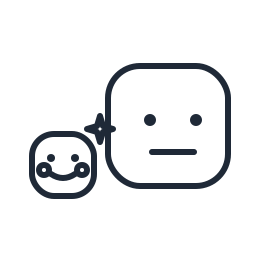
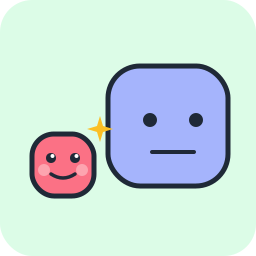
Little in size or amount, not big.
Test yourself on small
Three quick questions. No account needed.
Know this word? Create a free account to track it.
Word origin
From Old English smael, meaning slender or narrow, shared with other old Germanic languages.
- Origin
- Old English
- Root
- smael
Examples
.
"Small" shows the house is little in size.
.
Here "small" means a little amount.
.
"Small" tells us the dog is little, not big.
Where this fits
Used in
Stories
(26)Has Anyone Seen a Coat?
2 min read · Core 1000
The List on the Door
2 min read · Core 1000
Two Stars
2 min read · Core 1000
At the Doctor
3 min read · Core 1000
Lost in Town
3 min read · Core 1000
The Late Bus
3 min read · Core 1000
Police Notes
3 min read · Core 1000
One Sheep Short
4 min read · Core 5000
The Broken Window
4 min read · Core 5000
The Clock in the Hall
4 min read · Core 5000
The Letter She Never Sent
4 min read · Core 5000
The Passenger
4 min read · Core 5000
Two Gardens
4 min read · Core 5000
Not in Front of Them
5 min read · Core 1000
The Box in the Wood
5 min read · Core 5000
The First Letter
5 min read · Core 5000
The Midnight Piano
5 min read · Core 5000
The Night Route
5 min read · Core 5000
The Photograph
5 min read · Core 5000
The Register
5 min read · Core 5000
The Suggestion Box
5 min read · Core 5000
The Swimming Lesson
5 min read · Core 5000
The Tuesday Visitor
5 min read · Core 5000
The Whale on the Beach
5 min read · Core 5000
Two Tickets to Paris
5 min read · Core 5000
The Last Light
8 min read · Core 5000
Grammar articles
(35)English adjective order: opinion, size, age, shape, colour
Advanced English articles: zero article and the with places
Articles in English: a, an, the and the zero article
Asking for directions in English: turn left, go straight on
British vs American English Grammar: got, gotten and more
Clothes in English: trousers, a shirt and a pair of shoes
Comparatives and superlatives in English: rules and chart
Days, months and seasons in English: on Monday, in May
Discourse Markers in English: well, anyway, actually
Ellipsis and substitution in English: I think so, so do I
Emphasis in English: emphatic do, my own and the very
English Filler Words: um, well, so, like, you know
For, since, already, yet and still in English, with examples
Gerund and infinitive in English: verb lists and rules
English greetings and survival phrases for beginners
Hedging and vague language in English: sort of, a bit, -ish
English Question Words and Interrogative Pronouns
Linking Words in English: although, despite, however
Must, have to and should in English: rules and examples
Numbers in English: how to say, write and spell them
Past continuous in English: was/were + -ing, with examples
Past modals in English: should have, could have, must have
Phrasal-prepositional verbs in English: 16 with examples
100 Common Phrasal Verbs in English, with Examples
Phrasal verbs with take in English: 12 meanings, examples
Phrasal Verbs in English: Meaning, Rules and Examples
Plurals in English: one cat, two cats (rules and chart)
Prepositions in English: in, on, at and more, with examples
Present continuous in English: am/is/are + -ing, examples
Present perfect in English: rules, for and since, examples
Quantifiers in English: some, any, much, many, few, little
Question tags in English: rules, examples and aren't I
Separable and inseparable phrasal verbs in English: rules
I wish and if only in English: grammar rules and examples
How to say years in English: 1984, 2005, 2025
Add to review queue
Track this word in your spaced-repetition queue and be tested on it at the right interval.
Meet this word in a story
Every course has graded stories written only with words you have been taught, plus grammar drills, a games arcade and printable worksheets. Chapters 1 and 2 are free.
Chapters 1 and 2 free, forever. Plus: 7 days free, then $5 a month for all eleven languages.
English · Free printables
small: worksheet, infographic and listicle
Free printable study downloads for the English word "small" (Little in size or amount, not big.): a worksheet with the answer key built in, an infographic, and a sentence listicle. Open any one to view, print or save.
Free for members
The printable worksheets, infographics and PDFs are free with an account. Start a free week and download as many as you like.
Start your free weekThis word is taught in chapter 5, lesson 10: small, hurry, lord and 7 more words.