
/ˈeso/
Translation
that (general/neuter)
Word origin
Neuter form from Latin ipsum, the neuter of the demonstrative ipse ('that very one'), used for ideas and unidentified things.
- Origin
- Latin
- Root
- ipsum
Examples
.
That is exactly what I wanted to say.
¿ ?
What is that you have in your hand?
.
That does not seem like a good idea to me.
.
That is why I could not get to the meeting on time.
, .
After that, nobody spoke about the topic again.
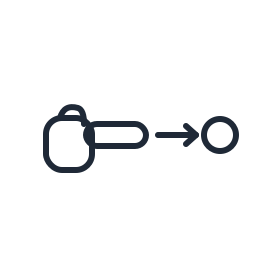
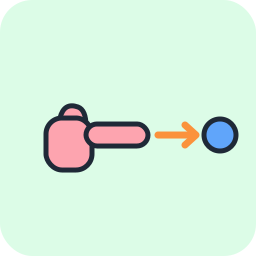
is the neuter demonstrative pronoun in Spanish, referring to an idea, situation, action or unidentified object at medium distance from the speaker. Unlike its masculine and feminine cousins ese and esa, eso never modifies a noun directly: you say ese libro (that book), not eso libro. Reserve eso for moments when you are pointing at a fact, a clause, or something whose gender you do not know or do not need to specify.
The pair esto / eso / aquello tracks distance from the speaker exactly the way este / ese / aquel do for masculine nouns: closest, mid-range, far. Eso has no plural and no gendered counterpart; it is a single fixed form. Idiomatic uses are everywhere: por eso (that is why), eso es (exactly), y eso que (even though), en eso (just then). See the Spanish demonstratives guide for the full system.
Where this fits
Used in
Stories
(14)Aquí, en casa
1 min read · Core 1000
¿Vienes o no?
1 min read · Core 1000
Un día con María
2 min read · Core 1000
Casi no llega
3 min read · Core 1000
El nuevo doctor de Paula
3 min read · Core 1000
La habitación libre
3 min read · Core 5000
Laura busca piso
3 min read · Core 5000
Le hice arreglar el coche
3 min read · Core 5000
Lo que de verdad importa
3 min read · Core 5000
María lleva una hora esperando
3 min read · Core 5000
No creo que sea grave
3 min read · Core 5000
No fue él, sino ella
3 min read · Core 5000
El primer día de Laura
4 min read · Core 1000
Palabras de cocina
5 min read · Core 1000
Grammar articles
(15)Spanish Cleft Sentences and Emphasis: fue Pedro quien, lo que quiero es
Spanish Text Cohesion and Style: signposting, avoiding repetition, en resumen
Spanish Conditional: the 'Would' Tense, me gustaría and Polite Requests
How to Say Therefore, So and Because in Spanish: por lo tanto, así que, porque
How to Say However, Even Though and Despite in Spanish: sin embargo, aunque, a pesar de
Este or Esta? Matching Spanish Demonstratives to Gender and Number
Demonstrative Pronouns in Spanish: Este, Ese, Aquel and the Three-Way This and That
Spanish Demonstrative Adjectives: este, ese, aquel and the Three-Way Distance Split
Spanish False Friends (Part 2): molestar, recordar, soportar, pretender
Spanish Indefinites: alguno, ninguno, alguien, nadie, algo, nada, cualquiera
Spanish Nosotros Commands: the 'Let's...' Form
The Spanish Present Perfect Subjunctive (haya hablado), with Practice
Spanish Compound Prepositions and Tricky Choices: delante de, a pesar de, soñar con
Spanish Set Phrases with tener, dar, hacer, echar (tener ganas, echar de menos, hacer falta)
Spanish Word Order: SVO, Pro-Drop and the Five Rules That Cover 90% of Sentences
Add to review queue
Track this word in your spaced-repetition queue and be tested on it at the right interval.
Go to my review queueSpanish · Free printables
eso: worksheet, infographic and listicle
Free printable study downloads for the Spanish word "eso" (that (general/neuter)): a worksheet with the answer key built in, an infographic, and a sentence listicle. Open any one to view, print or save.
Free for members
The printable worksheets, infographics and PDFs are free with an account. Start a free week and download as many as you like.
Start your free weekThis word is part of lesson 1.