
Translation
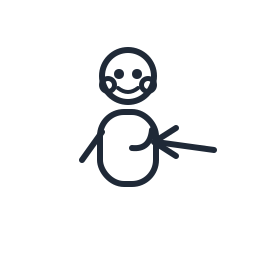
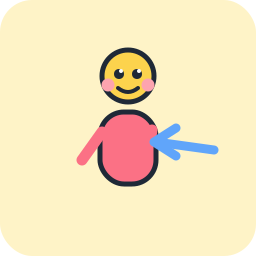
The word the speaker uses for themselves when they receive the action.
Know this word? Create a free account to track it.
Examples
.
"Me" means the speaker is the one being helped.
.
"Me" shows the speaker receives the book.
.
"Me" is the person who got the call.
Where this fits
Used in
Stories
(17)A Little Thing
1 min read · Core 1000
The First Day
2 min read · Core 1000
A Day at the Farm
3 min read · Core 1000
A Rainy Afternoon
3 min read · Core 1000
At the Doctor
3 min read · Core 1000
Cooking Together
3 min read · Core 1000
Lost in Town
3 min read · Core 1000
Sports Day
3 min read · Core 1000
The Late Bus
3 min read · Core 1000
The Phone Call
3 min read · Core 1000
Before the Doors Open
4 min read · Core 5000
The Broken Window
4 min read · Core 5000
The First Letter
5 min read · Core 5000
The Night Route
5 min read · Core 5000
The Swimming Lesson
5 min read · Core 5000
The Tuesday Visitor
5 min read · Core 5000
Two Tickets to Paris
5 min read · Core 5000
Grammar articles
(47)Advanced English articles: zero article and the with places
Both, either and neither in English: rules and examples
British vs American English Grammar: got, gotten and more
Have something done and get something done in English
Cleft sentences in English: it-clefts and wh-clefts
Comparatives and superlatives in English: rules and chart
Conditional sentences in English: zero, first, second, third
Countable and uncountable nouns in English: rules and list
This, that, these and those in English: chart and examples
Discourse Markers in English: well, anyway, actually
Ellipsis and substitution in English: I think so, so do I
Emphasis in English: emphatic do, my own and the very
For, since, already, yet and still in English, with examples
Future continuous and future perfect in English: examples
Gerund and infinitive in English: verb lists and rules
English Grammar Test: 30 Questions with Answers (A2-B2)
English greetings and survival phrases for beginners
Hedging and vague language in English: sort of, a bit, -ish
Indirect Questions in English: Word Order and Examples
English Question Words and Interrogative Pronouns
Inversion and subject-verb-object word order in English
Mixed conditionals in English: rules, examples and exercises
Modal verbs in English: rules, examples and how to use them
Participle clauses in English: -ing, -ed and having done
Advanced passive in English: get-passive, it is said that
Passive voice in English: rules, examples and when to use it
Past modals in English: should have, could have, must have
100 Common Phrasal Verbs in English, with Examples
Phrasal verbs with get in English: 16 meanings, examples
Phrasal verbs with go in English: 14 meanings, examples
Phrasal verbs with put in English: 13 meanings, examples
Phrasal Verbs in English: Meaning, Rules and Examples
Present continuous in English: am/is/are + -ing, examples
Question tags in English: rules, examples and aren't I
Reflexive and reciprocal pronouns in English, with examples
Relative clauses in English: defining and non-defining
Reported speech in English: backshift table and examples
Reporting verbs in English: a list of patterns and examples
Separable and inseparable phrasal verbs in English: rules
The subjunctive in English: if I were you, I suggest he go
There is and there are in English: rules and examples
Time clauses in English: when, while, until, as soon as
Used to, would and be used to in English: past habits
Verb patterns with objects in English: want, make, let, see
I wish and if only in English: grammar rules and examples
Prefixes in English: un-, in-, im-, ir-, dis-, mis- rules
Suffixes in English: word building with -ness, -ful, -ly
Add to review queue
Track this word in your spaced-repetition queue and be tested on it at the right interval.
English · Free printables
me: worksheet, infographic and listicle
Free printable study downloads for the English word "me" (The word the speaker uses for themselves when they receive the action.): a worksheet with the answer key built in, an infographic, and a sentence listicle. Open any one to view, print or save.
This word is taught in chapter 1, lesson 3: People words.