
/bæk/

Translation
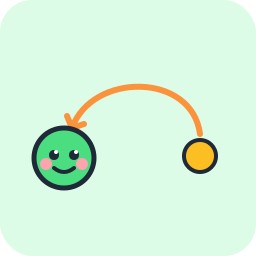
Towards the place or position where someone or something was before.
Examples
.
"Back" means return the pen to me.
.
"Back" shows she returned to the place she came from.
later.
"Back" means to answer your call in return.
Used in
Stories
(26)A New Day
1 min read · Core 1000
A Day at the Farm
3 min read · Core 1000
At the Doctor
3 min read · Core 1000
The First Day at Work
3 min read · Core 1000
Sports Day
3 min read · Core 1000
The New Neighbour
3 min read · Core 1000
The Rescue
3 min read · Core 1000
Before the Doors Open
4 min read · Core 5000
One Sheep Short
4 min read · Core 5000
The Boat in the Garden
4 min read · Core 5000
The Clock in the Hall
4 min read · Core 5000
The Letter She Never Sent
4 min read · Core 5000
The Passenger
4 min read · Core 5000
Two Gardens
4 min read · Core 5000
Not in Front of Them
5 min read · Core 1000
The Box in the Wood
5 min read · Core 5000
The First Letter
5 min read · Core 5000
The Midnight Piano
5 min read · Core 5000
The Night Route
5 min read · Core 5000
The Photograph
5 min read · Core 5000
The Register
5 min read · Core 5000
The Swimming Lesson
5 min read · Core 5000
The Tuesday Visitor
5 min read · Core 5000
The Whale on the Beach
5 min read · Core 5000
Two Tickets to Paris
5 min read · Core 5000
The Last Light
8 min read · Core 5000
Grammar articles
(36)Causative have and get in English: have something done, get something done and having someone do it
Cleft sentences in English: it was X who, what I need is, and how to move the emphasis
Compound nouns in English: car park, coffee cup, and why GREENhouse is not green HOUSE
Conditional sentences in English: the four types explained
Countable and uncountable nouns in English: advice, information, news and the ones you simply have to learn
Discourse markers in English: well, anyway, actually, mind you and by the way
Dummy subjects in English: it's raining, there's a problem, and why the subject slot is never empty
Ellipsis and substitution in English: I think so, neither do I, and the words you are allowed to leave out
Emphasis in English: I do like it, my own, the very, and how to push back
For, since, already, yet and still in English: which word, and where it goes in the sentence
Future continuous and future perfect in English: will be doing vs will have done
Future in the past: was going to, would, was about to, and the grammar of plans that failed
Future tense in English: will, going to and more explained
English grammar test: 30 questions with answers (A2-B2)
Indirect questions in English: Could you tell me where the station is, and the word order that goes with it
Inversion and word order in English: the subject-verb-object spine and when it flips
Irregular verbs in English: the full list by pattern
Mixed conditionals in English: past causes with present results, and present causes with past results
Nominalisation in English: arrive becomes arrival, decide becomes decision, and why written English turns actions into things
Participle clauses in English: -ing and -ed clauses, and the dangling participle trap
Past modals in English: should have, could have, must have and might have
Past perfect tense: had plus past participle, and when English actually needs it
Phrasal verbs in English: rules, examples and how to use them
Prepositions in English: place, time and movement explained
Present perfect continuous: have been doing, and how it differs from the present perfect
Question tags in English: the mirror rule, aren't I, and tags after let's and imperatives
Reflexive and reciprocal pronouns in English: myself, yourself, each other, and when English does not bother
Relative clauses in English: defining, non-defining and when to drop the pronoun
Reported speech in English: backshift, questions and commands
Reporting verbs in English: admit, deny, suggest, promise, and the pattern welded to each one
English tenses explained: all 12 with a master table
Time clauses in English: when, while, as soon as, until, before and after
Verb patterns with objects in English: want somebody to do, make somebody do, and see somebody doing
Wish and if only in English: wish + past, wish + past perfect, wish + would, and why I wish I would is wrong
Word formation with prefixes: un-, in-, im-, dis-, re-, over-, under- and mis-
Word formation in English: how suffixes build word families and give away the part of speech
Add to review queue
Track this word in your spaced-repetition queue and be tested on it at the right interval.
Go to my review queueThis word is part of lesson 2.