
/deˈxaɾ/

Translation
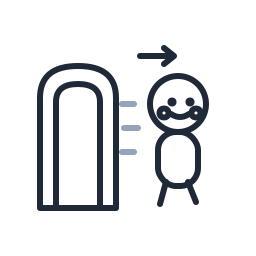
to leave, to let, to allow
Word origin
From Latin laxare ('to loosen, to slacken, to let go'), from laxus ('loose'). The initial d- arose in the Romance development of the word.
- Origin
- Latin
- Root
- laxare
- English cognates
- lax, relax
Grammar
Conjugation
Regular -ar conjugation. Pronouns: yo, tú, él/ella/ud., nos., vos., ellos/uds..
Indicative
| Person | Present | Preterite | Imperfect | Future | Conditional |
|---|---|---|---|---|---|
| yo | dejo | dejé | dejaba | dejaré | dejaría |
| tú | dejas | dejaste | dejabas | dejarás | dejarías |
| él/ella/ud. | deja | dejó | dejaba | dejará | dejaría |
| nos. | dejamos | dejamos | dejábamos | dejaremos | dejaríamos |
| vos. | dejáis | dejasteis | dejabais | dejaréis | dejaríais |
| ellos/uds. | dejan | dejaron | dejaban | dejarán | dejarían |
Subjunctive
| Person | Present | Imperfect (-ra) | Imperfect (-se) |
|---|---|---|---|
| yo | deje | dejara | dejase |
| tú | dejes | dejaras | dejases |
| él/ella/ud. | deje | dejara | dejase |
| nos. | dejemos | dejáramos | dejásemos |
| vos. | dejéis | dejarais | dejaseis |
| ellos/uds. | dejen | dejaran | dejasen |
Imperative
| Person | Affirmative |
|---|---|
| tú | deja |
| ud. | deje |
| nosotros | dejemos |
| vosotros | dejad |
| uds. | dejen |
Non-finite
- Gerund / present participle
- dejando
- Past participle
- dejado
Examples
.
I do not want to leave this job so soon.
Déjame , .
Let me speak for a moment, please.
.
Leave the keys on the table.
.
My grandmother left the recipe inside an old book.
.
The teacher will let us leave early if we finish quickly.
.
My grandmother left the recipe on the kitchen table.
.
I left the keys inside the car again.
Where this fits
Used in
Stories
(23)Lo mismo de siempre
2 min read · Core 1000
Alguien que lo haya visto
3 min read · Core 5000
El nuevo doctor de Paula
3 min read · Core 1000
El perro del barrio
3 min read · Core 5000
El trabajo de Pedro
3 min read · Core 1000
Es importante que descanses
3 min read · Core 5000
Espero que vengáis
3 min read · Core 5000
La habitación libre
3 min read · Core 5000
La llamada
3 min read · Core 1000
Le hice arreglar el coche
3 min read · Core 5000
Lleva toda la mañana
3 min read · Core 5000
María lleva una hora esperando
3 min read · Core 5000
Más vale tarde que nunca
3 min read · Core 5000
Media docena de huevos
3 min read · Core 5000
Menudo desastre
3 min read · Core 5000
No creo que sea grave
3 min read · Core 5000
Por todas partes
3 min read · Core 5000
Se me cayó todo
3 min read · Core 5000
Se vende la camioneta
3 min read · Core 5000
Tú y tu hermano
3 min read · Core 5000
Una organización imposible
3 min read · Core 5000
El primer día de Laura
4 min read · Core 1000
La cena de los Pereira
4 min read · Core 1000
Grammar articles
(5)Spanish Advanced Grammar (C1-C2): The Constructions That Sound Native
Spanish Causative Verbs: hacer, dejar, mandar + Infinitive (me hizo esperar, le hice arreglar el coche)
The Spanish Infinitive as a Noun and After Prepositions (antes de salir, al llegar)
Spanish Verbal Periphrases: acabar de, llevar, volver a, seguir + verb
Verbs with Prepositions in Spanish (Régimen Preposicional): the Fixed Verb + Preposition Pairs
Add to review queue
Track this word in your spaced-repetition queue and be tested on it at the right interval.
Go to my review queueSpanish · Free printables
dejar: worksheet, infographic and listicle
Free printable study downloads for the Spanish word "dejar" (to leave, to let, to allow): a worksheet with the answer key built in, an infographic, and a sentence listicle. Open any one to view, print or save.
Free for members
The printable worksheets, infographics and PDFs are free with an account. Start a free week and download as many as you like.
Start your free weekThis word is part of lesson 2.